| |
|
Bonnie Prince Charlie
and the Jacobites
|
|
By Simon Hill, MA Hons.
(Scottish History) Edinburgh
|
|
|
|
|
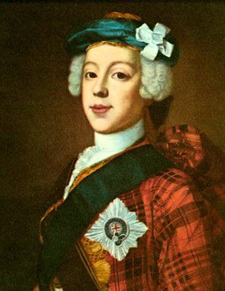
Charles Edward Stuart
|
|
Bonnie Prince Charlie
|
|
|
It
must be pointed out before we begin, that there
is a common misconception that the principle
Duncan family of that time, the Duncan's of
Seaside & Lundie and in particular Adam
Duncan of Lundie, later to become Admiral Duncan Viscount
Camperdown were Jacobites. This is not the
case, they were known Hanoverians. Adam Duncan
as a young Naval midshipman
on the frigate "Shoreham" under Captain Robert
Haldane also a Hanovarian, were
in fact in pursuit of the Bonnie Prince's
French ship round the coast of Scotland.
However Duncan's, as did many other Scottish
families at that time did have supporters on
both sides, Jacobite and Government.
Jacobite
cause was the name given to supporters of King
James VII of Scotland and II of Britain who fled
from the country in 1689 to escape an invading
army led by William of Orange (also known as
King Billy). There was fear throughout Britain
that James would re-instate Catholicism as the
national religion so the parliaments invited his
daughter Mary and her Protestant husband William
to take over the throne. The decisive battle of
the Boyne in Ireland saw James completely
defeated and he left the British Isles.
|
 |
|
|
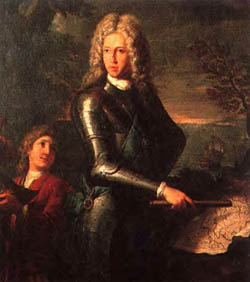
Prince James Francis
Edward Stuart
|
|
|
'The Old Pretender',
|
|
|
His
son was born in 1688, James Francis Edward
Stuart (the Old Pretender) was to have been
James III of Britain. However the flight of his
father meant that he grew up in exile. He took
part in the aborted invasion of 1708 with French
assistance and went on to lead the 1715 uprising
which also ended in failure. Although brave and
honourable James was largely ineffectual and
continually suffered from bad luck earning him
the nickname 'Old Mr. Misfortune'. The Old
Pretender had two children, Charles and Henry.
Charles went on to become known as Bonnie Prince
Charlie, while Henry became a Cardinal in the
Catholic Church. Both were raised in Rome and
protected and supported by the pope,
particularly in their later years.
The
Stuart's Catholicism prevented many would-be
supporters who were Protestant from joining the
cause. Although some Protestants did become
Jacobites the fear in Britain that the Stuarts
would re-introduce Catholicism as the official
faith dealt a blow to their restoration efforts.
The Jacobite court settled in Rome in 1719 and
was protected and partially funded by the pope
from then until the death of Henry in 1807. Many
countries wanted to support the Jacobite cause
and return the Stuarts to the throne so they
would be treated favourably by Britain, or
because they disliked William
of Orange. The
|
|
Stuarts
always looked to France first for aid as it was
the strongest Catholic power, it had a long
rivalry with England and it was close. Louis XIV
of France supported James VII until 1713 when he
repudiated the Jacobites and expelled the Old
Pretender. Once again in the 1740's the French
prepared to invade but were prevented by poor
weather and the 1745 rising failed.
Charles
fled to France after the defeat but was expelled
so the French could make peace with Britain.
King Charles XII of Sweden also proposed to help
the Jacobite campaign by providing 10,000 troops,
however negotiations broke down
in 1718 because the Swedish
king died. Sweden remained on good terms with
the Jacobites and even sent a secret regiment
for unacknowledged service in Scotland in
1745. Other offers of help from Spain and
Russia broke down due to problems in
negotiations and the weather prevented the
Spanish armada from assisting the 1719 rising.
|
|
Many
of these negotiations for foreign support were
not helped by the manners of Bonnie Prince
Charlie. He was a heavy drinker and became angry
when things did not go his way. The Prussians
withdrew support after Charles had become
extremely drunk and insulted them publicly.
Jacobites had their own material culture and an
underground society. They wore secret symbols to
illustrate their allegiance to the Stuarts and
often met in Jacobite taverns to sing seditious
songs or to drink to the king over the water.
Many songs were popular amongst the Jacobites
and some have survived through to the modern
day, 'The Bonnie Banks of Loch Lomond' for
example. People would wear a white rose to
celebrate the Old Pretender's birthday or a
white cockade on their hat to show their support
of Jacobitism. Jacobites are also often
associated with tartan; of course the
Highlanders who fought for the Stuarts were
mostly clad in their clan tartans.
Also
in the 1740's another way of displaying Jacobite
sympathies was to wear a tartan waistcoat. A
prominent English Jacobite had an entire tartan
suit made and it can now be seen on display at
the National Museum of Scotland, in Edinburgh.
The traditional kilt was banned for a time after
the defeat of the Jacobites because of its rebel
associations. There were several military
campaigns in Britain in support of the
Jacobites but all of .
|
| |
|
| |
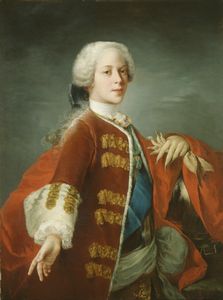
Prince Henry Benedict
Stuart
|
|
later Cardinal York
|
|
|
them
were flawed either in planning or execution and
sometimes in both. Risings took place in 1715,
1719 and most famously in 1745, not to mention
the aborted rising planned in 1708. The earlier
risings included Highland and Lowland Scots,
English and French but in 1745 the Jacobite
force was almost exclusively made up of
Highlanders. Prince Charles landed on the small
island of Eriskay and gathered the loyal clan
Chiefs before advancing on Edinburgh.
The
Jacobite army took Edinburgh without much
resistance and defeated a government army
at Prestonpans by cleverly sneaking across
a marsh in the mist and surprise attacking them.
The Highlanders only wanted to take Scotland,
but Prince Charles was greedy for the English
throne and convinced the army to push on
southwards. He lied and
told them that English Jacobites
would meet up with the Highlanders further
south, in fact the English Jacobites
had decided not to join
the uprising. They
advanced to Carlisle then
Manchester, and
|
 |
|
|
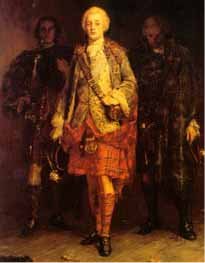
Prince Charles Edward
Stuart
|
|
|
'Bonnie Prince Charlie'
|
|
|
eventually
as far south as Derby. It was here with three
armies lining up to fight them that they
discovered Charles had been lying and made the
long retreat home. A sulky Bonnie Prince Charlie
accompanied them home, .drinking and moaning all
the way. Eventually the weary
Highlanders were cornered at Culloden and
slaughtered as Charles made his escape.
The
Jacobite struggle has been romanticised ever
since and helped create the image of the
Highlander as the loyal and brave soldier. Much
of the romanticisation of the Jacobite uprisings
especially in 1745 is unjustified. There are
several misconceptions surrounding this area of
history. Firstly the Jacobite cause was not
about Scotland versus England there were people
of each nationality on either side. Secondly
Bonnie Prince Charlie, although highly
charismatic, was no hero, he could be viewed as
a spoilt alcoholic aristocrat who had no problem
leading loyal men to their graves for his own
personal ambitions. Thirdly Jacobitism did not
really stand for a noble cause, it sought to put
the Stuarts back on the throne and they stood
for the 'divine right of kings' which meant they
believed the king was chosen by god and should
have absolute authority.
|
|
The
Stuarts also advocated the Catholic religion
(which many Scots were against). Ultimately it
seems strange that the Jacobites have been
immortalised on shortbread tins as a symbol of
Scotland. Whatever the reason, the Jacobite
cause has been remembered by Scots, and
appropriated as a nationalist symbol. The
memorial at Culloden
on the anniversary of the battle still attracts
huge crowds today.
|
| |
Acknowledgements:
Prince
Charles Edward Stuart, portrait by John
Pettie, copyright Royal Collection.
Culloden, by David Morier, copyright Royal
Collection. Prince Henry Benedict
Stuart, later Cardinal York, by Blanchet,
copyright Royal Collection. Prince
James Francis Edward Stuart, 'The Old
Pretender', copyright Blairs College. Author:
Simon Hill, Edinburgh some parts John A.
Duncan of Sketraw.
|
|
|
|
