|
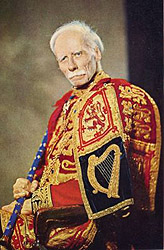
Sir
Crispin Agnew of Lochnaw, Baronet, QC,
Rothesay Herald of Arms and Chief of Clan Agnew,
also makes mention of Clan ‘septs’ in his
article ‘Clans, Families & Septs’;
“It
should also be said that the various Sept
lists, which are published in the various
Clans and Tartan books, have no official
authority. They merely represent some
person's, (usually in the Victorian eras)
views of which name groups were in a
particular clan's territory. Thus we find
members of a clan described, as being persons
owing allegiance to their chief "be pretence
of blud or place of thare duelling". In
addition to blood members of the clan, certain
families have a tradition (even if the
tradition can with the aid of modern records
be shown to be wrong) descent from a
particular clan chief. They are, of course,
still recognised as being members of the clan.
Historically,
the concept of "clan territory" also gives
rise to difficulty, particularly as certain
names or Septs claim allegiance to a
particular chief, because they come from his
territory. The extent of the territory of any
particular chief varied from time to time
depending on the waxing and waning of his
power. Thus a particular name living on the
boundaries of a clan's territory would find
that while the chiefs power was on the up they
would owe him allegiance but - if his power
declined retrospectively at some arbitrary'
date which the compiler of the list has
selected. Often the names are Scotland-wide
and so it is difficult to say that particular
name belongs to a particular clan. Often
surnames are shown as potentially being
members of a number of clans, and this is
because a number of that name has been found
in each different clan's territory. Generally
speaking, if a person has a particular sept
name which can he attributed to a number of
clans, either they should determine from what
part of Scotland their family originally came
and owe allegiance to the clan of that area
or, alternatively, if they do not know where
they came from, they should perhaps owe
allegiance to the clan to which their family
had traditionally owed allegiance.
Alternatively, they may offer their allegiance
to any of the particular named clans in the
hope that the chief will accept them as a
member of his clan. Equally, as has already
been said, with the variations from time to
time of particular chiefly territories, it can
be said that at one particular era some names
were members of or owed allegiance to a
particular chief while a century later their
allegiance may well have been owed elsewhere.
In
summary, therefore, the right to belong to a
clan or family, which are the same thing, is a
matter for the determination of the chief who
is entitled to accept or reject persons who
offer him their allegiance.”
|