| |
|
CULLODEN
MOOR
AND
THE STORY OF THE BATTLE |
|
Culloden House & Moor -
Chapter 2 |
|
| |
 |
|
Culloden House |
|
|
ON the evening of Monday,
the 14th of April, the Prince led out his troops to the parks around
Culloden House about 4 miles east of Inverness, where those under Lord John
Drummond also rendezvoused; and next day they were all marshalled in order
of battle on the Moor of Culloden, or, as it was then called, Drumossie
Moor, expecting the advance of the Royal army.
The hills on the south side of Loch Ness subside at the lower end of that
lake into a long, smooth swelling ridge, which gradually declines to the
eastwards and does not finally attain the level of the low ground till near
Nairn. This ridge rises with a lessening slope, as the elevation diminishes
from a great terraced plain which borders the firth and the river Ness on
the south about 90 feet high, forming a portion of a great gravel-terrace or
coast-line, which extends from the confines of Loch Ness through Inverness,
Nairn, and Moray shires, to the mouth of the Spey; having a line of similar
height and character opposed to it on the Ross-shire coast; indicating a
former elevation of the sea nearly corresponding with the summit- level of
the Great Glen reaching from sea to sea, which lies between Lochs Oich and
Lochy. The ridge contracts by degrees in width as it declines. Opposite
Culloden its base is about a mile removed from the shore; and, attaining
hereabouts an average elevation of some 470 feet above the sea, it extends
to the river Nairn — a stretch at this part, as the crow flies, of about two
miles, the summit for nearly a mile across being of a very gently rolling,
almost though not quite level surface, having slight depressions where, more
particularly, the. surface- water lodging rendered them wet and spongy or
marshy, which indeed the whole Moor is somewhat at that time of the year.
The view of the Moray and Beauly Firths and of the mountains of the northern
counties, and along the Great Glen, is truly magnificent. On the 15th and
16th, the Highland army was drawn up on the top of the ridge and their
position lay pretty near in a line with Culloden house on the summit of the
Moor, across which they extended towards the river Nairn, and fronting the
north- east.
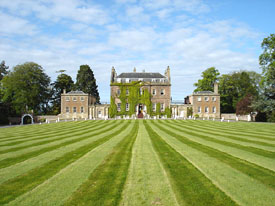
CULLODEN HOUSE
The present mansion, built about the year 1780, is a stately edifice, after
the fashion of English manor-houses of the period, consisting of a large
twin central building, high roofed and balustraded, the rooms in which are
spacious and finely proportioned, with two storeyed wings of like width
connected thereto by open-walled courts: all built of dark red, with
dressings of white, sandstone. It occupies the site of the old Castle (the
vaults of which form the sunk storey) near the foot of the ascent to the
Moor, and is surrounded by extensive and finely timbered park-ground. The
former edifice was an oblong building, surrounded by a high court-wall, and
was a place of some strength.
In October 1745, after the crafty Lord Lovat's inclinations to the Stuart
cause had become manifest to his clan, Fraser of Foyers made an unsuccessful
attempt to seize the Castle and the person of President Forbes, presuming no
doubt that these would prove acceptable acquisitions to his chief. It is not
ascertained that Lovat was privy to the scheme, with which he emphatically
disclaimed all complicity, though it has been asserted that at an early
stage he strongly recommended steps being taken to secure the person of the
President, and that he latterly attached great blame to the disregard of
this shrewd advice. The latter being ~ always on very friendly terms with
the old chief, but duly apprehending the extent to which he was to be
trusted, comments thus in a letter to him on the conduct of his vassals on
this occasion:—
"I very well know it would give your lordship more pain than it did me,
though no man of common equity who knows that they carried off my sheep,
robbed my gardener, and the poor weaver who is a common benefit to the
country, and carried off some of my tenants' cattle, will imagine that there
was the least countenance from any one about your lordship to this
transaction; nor should I now give you any trouble on a subject so
disagreeable, but that I am teased every hour with reports that the
gentlemen who failed of their principal aim, give it now out that they are
to pillage, burn, and destroy my innocent tenants." |
 |
|
|
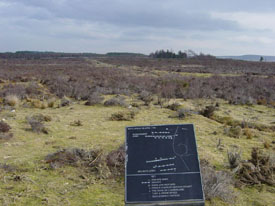
Culloden Moor |
|
|
In 1715 the old Castle was
also besieged by a party of Frasers, liege-men of MacKenzie of Fraserdale.
On this occasion, being defended by Mrs. Forbes, a cannon-shot from the
walls cut a branch off a tall old tree, which, stifled with ivy, long formed
a picturesque object on the lawn. The branch lighted on and killed one of
the besieging party.
The MSS. in possession of the Culloden family are valuable, and from them
one of the earliest of the selections by which Scottish history has been
illustrated from private archives, was published in 1815 — the Culloden
Papers, edited by the late Major Hugh Robert Duff of Muirtown. |
|
The hospitality of that
period was profuse, and sociality was carried to an extreme. Claret was the
favourite wine. The good cheer of the Culloden household was proverbial.
Burt (an English officer), in his Letters from the North of Scotland, thus
narrates the usages of the dinner-table:—
"It is the custom of that house, at the first visit or introduction, to take
up your freedom by cracking his nut (as he terms it), that is, a
cocoa-shell, which holds a pint, filled with champagne, or such other sort
of wine as you shall choose. You may guess by the introduction at the
contents of the volume.... As the company are disabled one after another,
two servants, who are all the time in waiting, take up the invalids with
short poles in the chairs as they sit (if not fallen down), and carry them
to their beds, and still the hero holds out." No wonder that Culloden was
known by the name of "Bumper John!"
"The types of true hospitality in a farmer's house of old," says Hill Burton
in his Life of President Forbes, "were said to be an anker of whisky, always
on the spiggot, a boiler with perpetual hot water, and a cask of sugar with
a spade in it. Culloden's hospitalities were of a more aristocratic order,
and the custom of the house was to prize off the top of each successive cask
of claret, and place it in the corner of the hall, to be emptied in pailfuls."
Such was the hospitality of the times, that even in the more temperate
establishment at Bunchrew, where his brother, Mr. Duncan Forbes, generally
resided, the convivialities occasioned an outlay, as appears from an old
account, of 40 in the course of a month for claret bought in individual
dozens at 16s. and 18s.
LORD PRESIDENT FORBES
Of Duncan Forbes, brother of John, Sir Walter Scott, in his review of the
Culloden Papers in the Quarterly Review, No. 28 (18I6), says:—
"He was promoted to the office of Advocate-Depute, and in 1725 to that of
Lord Advocate, always a situation of high power and importance, but
particularly so in times of a disputed title and repeated insurrections....
Placed as it were on the very verge of the discontented districts, he had a
difficult and even dangerous game to play. It was, says the editor of these
papers most truly, more congenial to his nature to reclaim than to punish,
and his life was spent in keeping quiet, by means of influence, persuasion,
and the interposition of friends, those warlike and independent chiefs whom
presumption and political prejudice were perpetually urging to take up arms.
"Lord Advocate Forbes suppressed, by his personal exertions, the desperate
and alarming riots concerning the malt tax in 1725, and was among the
patriots who saved the city of Edinburgh from the vindictive measures
meditated against the metropolis on account of the singular insurrection
called the Porteous Mob. It was indeed one of the brightest points of this
great man's character, that, though the steady friend of government and good
order, he was the boldest and most active mediator for his misguided
fellow-subjects, when it was proposed to urge punishment beyond the bounds
of correction into those of vengeance. Many other patriotic labours occupied
his attention, concerning which information will be found in these 'Papers.'
He was the first to give the example (since so well followed) of those
effects which careful agriculture can produce, even when contending with the
disadvantages of soil and climate. It was he who first proposed
encouragement to the linen trade and other manufactures in Scotland. It was
he also who first took measures for preserving and arranging the Records of
the kingdom of Scotland. The promotion of Forbes to the high office of
President of the Court of Session took place in 1737. When called, as Lord
Hardwicke expressed it, by the voice of the country to fill the vacant
chair, his appointment was hailed by all ranks as a guarantee for the
impartial administration of justice, and the gradual and sound elucidation
of law." |
|
To President Fortes belongs
the credit of suggesting to government, several years before the Forty-Five,
in the prospect of a war with France or Spain, and in anticipation of this
proving the signal for another rising in behalf of the Pretender, the
embodiment of a certain number of regiments of Highlanders for foreign
service. He proposed that an English or Scottish officer of undoubted
loyalty should be appointed colonel of each regiment, but that all the other
officers should be selected from a list he had drawn up of chiefs and
chieftains of the disaffected clans. "If government," he urged, "pre-engages
the Highlanders, in the manner I propose, they will not only serve well
against the enemy abroad, but will be hostages for the good behaviour of
their relations at home, and I am persuaded that it will be absolutely
impossible to raise a rebellion in the Highlands." (Home's History of
the Rebellion.) Had this plan not been rejected by a timid policy, in all
probability the Rising would never have taken place.
Sir James MacIntosh, in his
review of the Culloden Papers in the Edinburgh |
| |
 |
| |
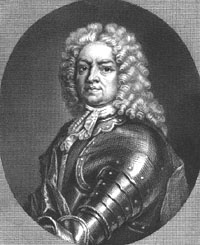
Simon Fraser Lord Lovat |
|
|
Review, No. 51 (1816), pays this noble testimony to the President:—
"There are various lords
and lairds who make but a shabby figure in this collection. But our great
pride and consolation is in the ever clear honour and open heart of him to
whom they address themselves. For Duncan Forbes no descendant will ever have
to blush or feel ashamed, and the perusal of this book will prove that
Scotland, ever since she ceased to be a separate kingdom, has had at least
one statesman whose principles were as pure as his understanding was
enlightened, and whose concern for his country was not so much as suspected
to be quickened by any regard to his own power or emoluments."
Hill Burton, in his Lives of Lord Lovat and Duncan Forbes (1847), thus sums
up the President's character, after narrating the closing scenes of his life
on 10th December 1747:—
"So died a man both great and good, who, like all the erring human race,
mingled some defects with his virtues; yet they were with him so open and
natural that they enable us the better to feel the reality of his
excellences, as part of a character that is set before us in all its merely
human proportions, and claims no ideal perfection. Five years after his
death, his fellow-lawyers erected a statue to his memory, worthily placed in
that noble old hall where the memory of his services and his character still
lives, as of one who uttered and elevated the tone of professional and
judicial morality in his day, and left even to the present generation a
greater legacy of sound and honest principles than they might have been able
to achieve without his aid. There is something in this statue of the florid
drapery and excited manner of its French artist, Roubillac; but the accuracy
with which the features are portrayed is sufficient to impart a solemn
dignity to the marble face, valence a slightly profuse tone in the adjuncts
of the statue makes a scarcely perceptible deduction. In this and in the
other representations of President Forbes, — for his portrait holds a
respected place in many a household and many a public institution of his
native country, — we can see that Nature, by a harmony of mental and
corporeal qualities not often exemplified, represented the excellences of
his mind with singular precision in a countenance which has scarcely been
excelled for the united expression of open honesty, firmness, intellect, and
gentleness."
|
 |
|
|
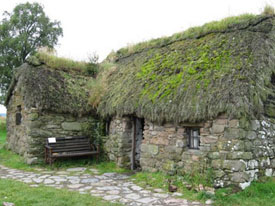
Cottage on Culloden Moor |
|
|
THE BATTLEFIELD.
The scene of conflict is about 5 miles from Inverness, and is intersected by
a district road which, about 2½ miles from Inverness, immediately behind the
house of Castlehill, strikes off on the left hand from the public road to
Perth, and leads to Kilravock and Cawdor, on the river Nairn. A monumental
cairn close by the roadside, a series of long trenches on the opposite side
of the road, and a few smaller ones on the north side, slightly raised above
the surface of the ground, and still distinguished by their vivid green turf
amid the brown heather, where the slain lie interred, mark the close
vicinity of the spot where the Royal left wing met the impetuous shock of
the Highland right and right centre. It is rather more than half-a-mile from
the Water of Nairn. |
|
Considerable portions of
the Moor around the scene of conflict are now under cultivation; but most of
the field of battle is moorland or fir and larch plantation. The Highland
army lay on the night of the 14th and morning of the 16th in a hollow on the
north edge of the Moor, outside of the fir plantation which skirts the birch
wood covering the northern hill-face, about three-fourths of a mile above
Culloden House, and to the west of the farm of Drumbuie. The position is
intermediate (but farther south) between a group of old pinetrees, called
"Steele's Mount," from their having been planted by a servant of the
President's of that name, and another group of pines, of about the same age,
about half-a-mile to the west; which groups from the low ground will be
discerned to overtop the here closely surrounding birch wood. The hollow is,
however, considerably nearer this west group than to Steele's Mount.
From this position the troops were moved across the Moor for more than
three-quarters of a mile, most probably for the sake of a degree of covering
to the right wing from a low stone dyke which lined the north side of a
large enclosure or park, and from which too other dykes extended on the east
and west sides to the river Nairn; and, probably with an eye to a possible
reverse, of vicinity to the hills south of the Nairn. It was, however,
withdrawing them out of the line of protection for Inverness. All traces of
these dykes have now disappeared.
A high stone fence now runs along the whole length on the north-west or
north side of the farm of Leanach for fully three-fourths of a mile, the
space to the river being laid out in large arable fields. About midway, and
a little to the east of the graves, it abuts, making an oblique bend, upon
the public road, along which it then rims nearly in the same line; but at
the west end, the public road and this fence are 400 yards apart. Here a
road runs down to the river, which is lined along the fields by another
stone fence of the same character, opposite which, and west of the road and
of Leanach farm, lies the farm of Culchuinag. Again, at the farther, the
north-east, end of the north fence, there is another fenced road leading to
the farmsteading of Leanach and across the Nairn. At the angle where this
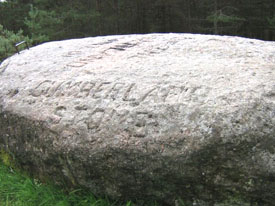
latter leaves the public road, there is a large flattish boulder stone,
called the "Duke's," or "Cumberland's Stone" where the Duke of Cumberland
stood when surveying the field of battle before coming to close quarters
(for then he was within the lines), and where part of his baggage was
placed. It is rather more than half-a-mile from the monumental cairn.
But there was also an old
low dyke pertaining to the farm of Old Leanach, which adjoined the northern
portion of the park, of which the old house (Old Leanach) is still to be
seen, — a black clay-built, straw-thatched cottage in a field, and not far
from the road, about 200 yards east of the graves. The Old Leanach
north-west or north dyke, somewhat of a continuation of the North Park dyke,
seems to have obliquely crossed the line of the new north fence, 50 yards
west of the present cross fence, and after a short interval to have turned
nearly parallel to the former, and to have terminated on the south side of
the clearing, about 100 yards west of the well, being 40 yards from the new
north fence; and the line, if produced, would cut the public road 70 yards
west of the point where the present north fence reaches it. |
|
The north side of the road
all along here is skirted, but for no great depth, by a fir and larch
plantation, which also occupies the whole triangular area on the south side
of the western moiety of the portion in question of the public road (800
yards), the north eastern terminal angle being at the point where the long
northern fence deflects to the public road. At this point, 25 yards south of
the centre of the road, there is a well, about 30 yards farther east than
the eastermost burial trench, and known as the "Black Well," or "Well of the
Dead," some of the wounded having crawled hither to die. The length of the
present north fence, from the west end of the planting to the well, is 700
yards. An irregularly oval clearing or open enclosure has been left at this
spot on both sides of the road for some 240 by about 100 yards in extreme
length and breadth. The principal trenches are in the
southern division, in a space of |
| |
 |
|
Cumberland Stone, Culloden
Battlefield |
|
|
about 130 by 25 yards of
extreme width; but there are two or three smaller and less prominent on the
north side of the road. The old north- west, or call it north dyke, of the
park at the west end commenced 130 yards south-east of the south angle of
the planting, or west angle of Leanach farm, close to, if anything a little
south of, a bend in the present south- west fence, and it ran in a line such
as, if prolonged, would meet the present north-west, or say north, fence,
about 30 yards north-east of the well; but it extended only for the length
of 350 yards. Here it was joined by another old dyke, that on the
north-east, or say east, side of the park, at about right angles towards the
junction, but making a bend to the east farther south, and then running to
the river-side. There was also, as indicated, a dyke on the west or
south-west side, near about the line of the present western fence. There is
a high cross stone fence now dividing the fields, which joins the north
fence, 450 yards, to the east. The line of the old east dyke, if produced,
would strike the present north fence 110 yards west of the present cross
fence; while the line of the old north dyke, if produced, would strike the
present cross fence 50 yards from the present north fence. These are the
only dykes mentioned by or seemingly known to Home and almost all other
writers.
APPROACHES TO THE
BATTLEFIELD
Pedestrians can most effectively shorten the walking distance (6 miles) from
Inverness to the battlefield, by taking the Highland railway train to
Culloden Moor Station, about a mile east of Cumberland's stone. But very
pleasant walks can be had by approaching the Moor from Allanfearn Station,
about three miles north-west of the stone. Two alternative routes present
themselves. One way is to pass the Allanfearn farm offices above the
Station, and turn to the right along a road running west, lined by an avenue
of trees, then by a cross road to the left, which will lead past the Mains
of Culloden farm-offices, and thence by the west end of the lawn in front of
the mansion house, past the stables, and between them and the dog-kennel,
and by a broad woodland pathway on the east side of a burn course,
slantingly up to the right through a birch wood, at one time covering the
hill-face but now partly cut down. This path crosses the Inverness to
Aviemore railway by a bridge on which is left in situ a stone known as the
"President's Seat," and conducts to the farm of Black Park, at the west end,
and south of the birch wood, and near the public road from Inverness, less
than half-a-mile west of the Stable Hollow house. The distance may be
shortened by, towards the middle of the ascent, holding right up the hill
and crossing the Moor ground to the west end of the fir and larch
plantation, or to the Stable Hollow house. Behind one of the small
farm-houses, also in Stable Hollow, and next to "King's Stables," on the way
in this direction, not far from the planting, a large protruding boulder
will be seen, where the country people concur in saying one of the Prince's
cannon was planted. On the way up the hill- face, but on the west side of
the burn in the birch wood near the top of the hill, there is a very fine
enclosed chalybeate well, called Tobar Mhoire or Mary's Well. It is much
resorted to by lads and lasses from Inverness on the first Sunday of May. |
 |
|
|
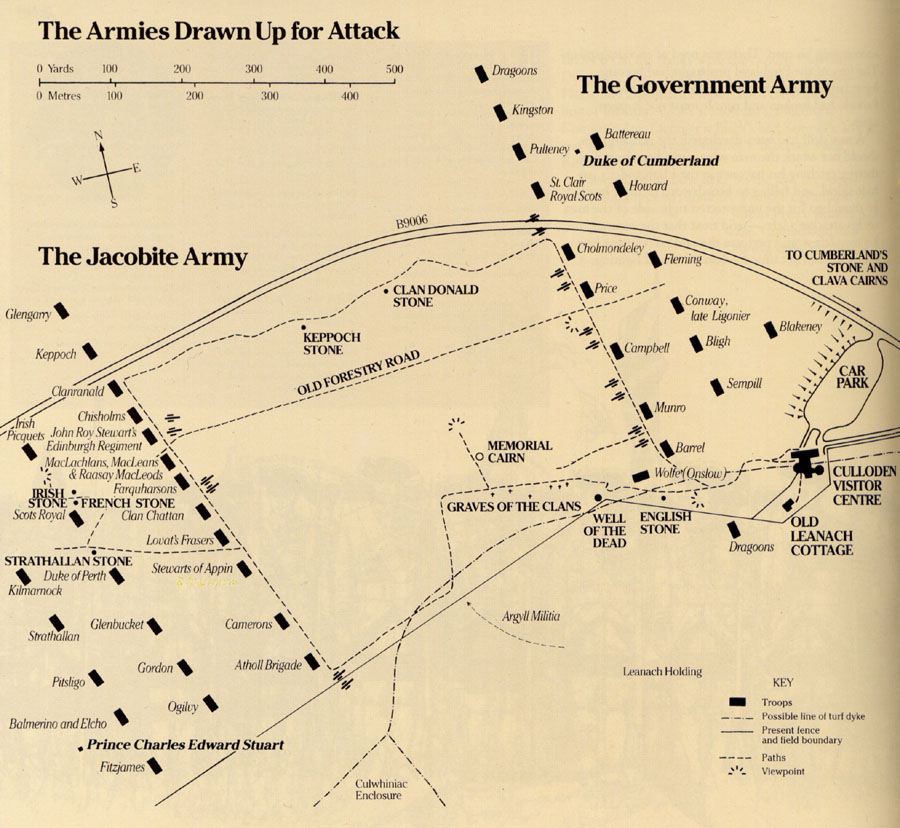
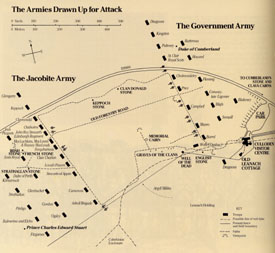
Battlefield Map - Click
for Larger Image |
|
|
To reach the east end of
the battle-field from Allanfearn Station, turn to the left after passing the
Allanfearn offices, — the next road, diverging to the right, will conduct in
a straight line to the west end of the small village of Balloch of Culloden.
From the east end of the village it ascends the face of the ridge, passing
by and by through a young fir plantation, and at the top through a belt of
older planting. Having surmounted the ascent and proceeded a few hundred
yards, the road strikes across the Moor, running through some young fir and
larch plantations emerges on the district-road from Inverness after having
crossed a track which, it may be observed is the remains of a road made by
Lord Lovat from Dalcross Castle to his property in Stratherrick. This latter
was the only roadway at the time of the battle through the Moor, which was
then, too, quite bare, though with a number of cottars' huts scattered over
it. |
|
The district-road is
reached at a point where bordered on the farther side by the extensive
arable farm of Leanach enclosed by stone dykes, the general survey of the
Moor is somewhat obscured by the rising plantation. The principal Graves and
the Cairn lie to the west (the right hand) about half-a-mile distant; while
again, on the opposite side, within the angle where the farm-road leads down
to the farm-steading of Leanach, there is, as already mentioned, the large
flattened boulder-stone, called the Duke's Stone.
The pedestrian need not retrace his steps, but, striking across the Moor,
somewhat more to the west than before, towards the farm-house of Drumbuie,
at the edge of the planting on the north face of the ridge, he will find a
pathway leading down through the plantation above Balloch to the group of
older and higher trees called Steele's Mount, and thence parallel to the
south and west fences of the park, and in front of Culloden House, whence
the previous directions will suffice. Or, from below Steele's Mount, he can
hold straight down through an avenue of pines to the west of Balloch
farm-house, and thence along a continuation of horse chestnuts to the east
of the back of Culloden House. Another return route will be afterwards
pointed out, from a little to the west of the Graves. If driving, however,
an agreeable circuit may be made by Dalcross Castle. The road by it to the
public road between Inverness and Nairn strikes off on the left hand about 3
miles from the Graves, passing Croy Free Church and Manse.
Such ground as Culloden Moor was obviously of the very worst description for
the tactics of Highlanders, while, if the Duke of Cumberland had had his
choice, he could scarcely have selected a locality more favourable for the
handling of regular troops, more especially when supported by horse and
artillery, although at that season there was a good deal of the ground in a
marshy state. The farther side of the river Nairn is bordered by a narrow
strip of high land, from which moorland hills, rising first in broken
terraces, gradually slope up to a considerable elevation the highest on
Culloden property being 1468 feet, and on MacIntosh's, immediately
adjoining, fully a couple of hundred feet higher; and form the northern
limits of a great expanse of hill country stretching to the Findhorn. On the
south side of the Nairn, then, the relative circumstances would have been
reversed, while the Highlanders could retire at will into intricate
fastnesses; and if they could induce their adversaries to follow them, the
contest could be indefinitely prolonged, and could scarcely fail to result
in disaster to regular troops. The north bank of the Nairn, too, though not
high, is here generally steep, and would present obstacles to the passage of
horse and artillery.
The situation did not escape the prescient eye of Lord George Murray, and he
had it examined by Brigadier Stapleton and Colonel Ker, who reported in
favour of the position and the Highland chiefs concurred in the opinion. The
Prince, however, influenced by his foreign advisers, who dreaded the
prospect of a probable campaign in the mountains, adhered to his
predilection for the open moor ground, in order, it is presumed, to cover
Inverness, where most of the baggage had been left. "What I can aver," says
Lord George, with reference to the advice to cross the Nairn, "is, that
myself and most of the clans, at least all I spoke with, were for this
operation and his Royal Highness could have supported the fatigue as well as
any person in the army. It's true Sir Thomas Sheridan, etc., could not have
undergone it, so we were obliged to be undone for their ease. As to
provisions, had I been allowed to have any direction, we would not have
wanted (though perhaps not of the best) for years, as long as there were
cattle in the Highlands or meal in the Lowlands."
[up^] |
|
|