| |
|
 |
|
Crest badge of Maj.
Robert Duncanson Argyll's Foot 1692 |
|
|
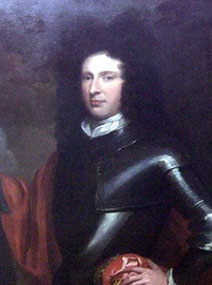
Major Robert
Duncanson, Argylls'Foot |
|
(The Massacre of
Glencoe) |
|
By John Duncan of Sketraw,
FSA Scot |
|
|
The Massacre of Glencoe.
That there was brutal cruelty and a breach of every kind of rule about
Highland hospitality is not in any doubt. That it was the settling of an
ancient score by the Campbell's against their sworn enemies the Macdonald's
is total fiction. The real culprit for the events of late 1691/early 1692 is
an "honour" shared by uncle and nephew. In London, William III decided to
use a soldier’s style of brutal example to reel in the rebel Highlanders. In
Paris, James II was too preoccupied with his mistresses and other vices.
William had issued an Offer of Pardon and Immunity to all Highland Chiefs
taking an oath of allegiance to him by 1st January 1692, William being in
Flanders at the time. James too so long to decide to permit the Chiefs to
relinquish their oaths to him that his messenger Duncan Menzies of Fornooth
only arrived back in Edinburgh on 21st December.
That only one chief hadn't been able to hear the permission and make his
oath within ten days is a miracle. Historians rarely blame James for what
happened, they should.
That MacIain of Glencoe was
some sort of bandit is not entirely true. That he was hated by the Campbells
is definitely not true. One Campbell hated him. Sir John Campbell of
Glenorchy, also known as Iain Glas and later as 1st Earl of Breadalbane, was
power mad and very jealous. He was jealous of the power his cousin, the Duke
of Argyll, Chief of Clan Campbell wielded, both at court and in his
homelands. |
|
|
On word reaching Argyll
that William intended to land, Argyll seized Glasgow and the West of
Scotland and declared for William. At the same time his friends like the
Earl of Sutherland also acted, in his case seizing Inverness and declaring
for William. Breadalbane was outmanoeuvred by his cousin again. He wanted to
become the top Campbell dog in the kennel. He also intrigued and became very
close to a cunning and ambitious lawyer, Sir John Dalrymple, Master of
Stair. Stair’s father had returned from exile with William and was created a
Viscount. His son wanted more and in 1691 became sole Secretary of State for
Scotland, which made him the most powerful man in Scotland, and at his side
was Breadalbane. Breadalbane was also jealous of the lands his cousin Argyll
controlled and he started eyeing up the lands of others. He wanted to expand
his sphere of influence within the western part of Scotland, north of his
cousin Argyll’s lands and this meant Northwest Perthshire and south west
Inverness-shire as well as that fringe of Argyllshire not fully controlled
by the Duke. |
 |
|
|
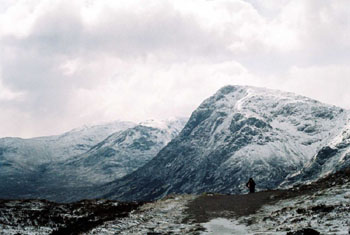
Glencoe Scotland |
|
|
There were already several
Lairds, Chiefs and Chieftains prominent in that area. The grandest was of
course the Great Lochiel, Chief of Clan Cameron. From his base in Achnacarry,
he ruled much of what today forms Lochaber District and such was the threat
of his strength and power, that the London based Government was to rebuild
and garrison the old fort at Maryburgh, now known as Fort William, among a
number of other forts in that pat of the western Highlands. Another man of
influence though little land was MacGregor of Glengyle. The problem here
though was that MacGregor’s wife Margaret was Breadalbane’s own first
cousin, sister of the next key player, Captain Robert Campbell of Glenlyon.
History has painted Margaret Campbell of Glenlyon not as one of those nasty
dastardly Campbells, but as the heroic mother of a heroic son. Yes Rob
Roy |
|
MacGregor was more Campbell
than anything else and through his mother claimed close ties of blood to the
two great Campbells, the Earl of Breadalbane and the Duke of Argyll. He was
to hide behind his Campbell cousin’s veil of protection many times during
his adult life, when the going got too tough and he was a wanted man.
A
third man of influence in the area was Margaret Campbell’s brother, Captain
Robert Campbell, 5th Laird of Glenlyon. A poor pale remnant of
the man he had once been, drinking and gambling as well as unwise
investments, had seen him dissipate his inheritance as a major Chieftain
within Clan Campbell and more and more he began to rely on the financial
handouts of his "generous" cousin Breadalbane. Never could he have envisaged
the effects both on him and his clan, when the "pay-back" came!
The
fourth character of major importance here was Alasdair MacDonald, 12th of
Glencoe. Known to history as "Red Alasdair" or MacIain, he
was the
Chieftain of a little, but fiercely proud part of that formerly great Clan
MacDonald, Lords of the Isles, who had watched as piece by piece, through
Royal intrigue and mistaken judgement, it had been pushed back to the mere
fringes of it’s former "realms". The main beneficiaries of the MacDonald
fall from grace had been, the Campbell Earls of Argyll! |
|
Back to 1692. William of
Orange wanted men for his armies and he couldn’t risk the Catholic elements
in Highland Scotland rising to support his father-in-law’s still active
claim for Restoration to the British throne. Although both the Scots and
English Parliaments strongly supported William, he wanted something to act
as a show of force. Stair and Breadalbane saw this as their chance to strike
and gain favour. I have mentioned the Oath and Pardon, which accompanied it.
Stair wanted to make an example of someone, regardless of whether the oath
was taken by all clans or not. MacIain provided him with his victim. Having
failed, through a combination of wrong information and bad advice to take
the oath on time, MacIain was sitting like a dead duck in the water, waiting
to be shot down. Stair and Breadalbane were ready to strike. |
| |
 |
| |
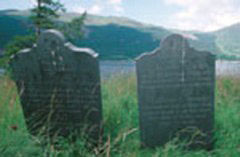
McLain Graves Glencoe |
|
| It is believed that
Breadalbane put the idea of the Massacre into Stair’s head. Breadalbane was
desperate to prove his loyalty since rumours had said, probably correctly,
that he had been flirting with The
Jacobite cause. Certainly he had entered into talks with the Jacobite
chiefs after the failed Risings of 1689. |
|
The first piece of
treachery came with the choice of Commander. In December 1645 and June 1646
and again in 1655, the MacDonalds of Glencoe had participated in raids on
Breadalbane, raids which both offended the pride and pocket of the Campbell
of Glenorchy. However the 1655 raids also took place in Glenlyon. Iain Glas
had waited a long time for revenge. What better way than to organise the
slaughter of MacIain and his brood. That Glenlyon was a willing participant
is highly unlikely. Glenlyon may have had no love of the Glencoe MacDonalds,
but he was closely related to them. The fact that Breadalbane was equally
closely related seems to have weighed little with him. Breadalbane’s father,
Sir John Campbell, 10th Laird of Glenorchy had a sister Jean. She is
probably the central figure in this entire story, or rather her marital
habits are!
Jean Campbell of Glenorchy
was both unlucky in her choice of husband and through those choices, the
central figure, as I have said. Her first husband quite naturally came from
within her Campbell family. She married Archibald Campbell, Heir to Glenlyon
and that marriage produced the ill-fated Captain Robert Campbell, 5th of
Glenlyon and his heroic sister, Margaret MacGregor of Glengyle, thus also
making her Rob Roy’s maternal grandmother. Archibald died in 1640 so she
moved on to husband number two, Patrick Roy MacGregor of Roro and this took
her slap bang into the middle of the Clan her daughter was subsequently also
to marry into. She didn’t wait long until she was widowed again but still
had time for another husband and this time it was Duncan Stewart of Appin,
another family which was to play a leading role in the Jacobite saga to
follow as anyone who has read Kidnapped by Robert Louis Stevenson will know.
I know that was a work of fiction, but the alliances and many of the people
referred to did live, but under another identity. Jean Campbell, aunt to
Breadalbane, mother of Glenlyon and grandmother of Rob Roy, managed to bear
15 children between her first two husbands but still had time to provide
Duncan Stewart, 3rd Laird of Appin with one as well. Their daughter married
yet another Campbell, a Campbell of Lochnell and a daughter of that union,
Sarah Campbell of Lochnell married Alasdair Og, second son of MacIain of
Glencoe. Thus by virtue of her multiple marriages and off-spring, Jean
Campbell of Glenorchy made Sarah MacDonald of Glencoe the first cousin once
removed of Breadalbane, the niece of Glenlyon and the first cousin of Rob
Roy. Confused? You should be!
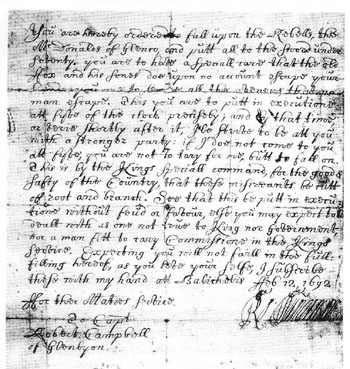
Major Duncanson order to
Cambell of Glenlyon |
 |
|
|
Duncanson's order to
Glenlyon, 12 Feb 1692 |
|
|
Ballacholis
Feb. 12, 1692
Sir:
You are hereby ordered to fall upon the Rebels, the MacDonalds of Glencoe,
and put all to the sword under 70. You are to have especial care, that the
Old Fox and his Sons do upon no account escape your Hands, you are to
secure all the avenues that no man can escape: this you are to put in
Execution at five a Clock in the Morning precisely, and by that time or
very shortly after it, I’ll strive to be at you with a stronger party. If
I do not come at five, you are not to tarry for me but fall on. This is by
the King’s Special command, for the good and safety of the country, that
these miscreants may be cut off root and branch. See that this be put in
execution without Feud or Favor, else you may expect to be treated as not
true to the King or Government nor a man fit to carry Commission in the
King’s Service. Expecting you will not fail in the fulfilling hereof as
you love yourself, I subscribed these with my hand.
Signed Robert Duncanson
For Their Majesties Service
To Captain Robert Campbell of Glenlyon |
|
|
It is quite clear that at
the time Glenlyon led his two Companies of men into Glencoe, he didn’t know
what was to happen. In December 1691 and January 1692, Breadalbane and Stair
wrote via General Sir Thomas Livingstone and Colonel John Hill to Lowland
officers Lieutenant-Colonel James Hamilton and Major Robert Duncanson of
Fassokie, clearly stating that he wanted the MacDonalds of Glencoe wiped
out. Hamilton and Duncanson planned the Massacre. There is no doubt that
Breadalbane suggested Glenlyon as the fall guy and given his financial
dependence on Breadalbane, Glenlyon had the impossible choice of breaching
the Highland code of Hospitality by killing MacIain and his people,
including potentially his own niece Sarah, or disobeying a military order
and at the same time betraying his duty of allegiance to his cousin and
financial backer, Breadalbane. He only received the orders on the 13th
February 1692, the day of the Massacre, issued the day before by Duncanson.
We all know what decision he took and it ruined both the rest of his life
and his clan’s name in Scottish history. The unanswered question remains,
why were so few murdered and so many escaped? Was it perhaps that neither
Glenlyon nor the few Highlanders within his command could really stomach
their orders and turned a blind eye to many MacDonalds escaping.
The last myth to be
debunked in part one of this tale is the Campbells doing the slaughter. It
is recorded that out of 135 men thought to be present and participating in
the slaughter, there were 15 Campbells including Glenlyon and the other
Campbell officers, hardly a majority or even a large minority. Maybe one day
an old document will be discovered in some long abandoned attic somewhere in
the Highlands and the recollections of someone present, written all those
years ago will come to reveal the real heroes and villains. Until then all
we can do is speculate but we must leave the myths and false claims to
Hollywood. |
| |
Acknowledgements:
Bibliography: A Pageant of History
published 1970 by William Collins and Son, Glasgow' Glencoe published 1966
by John Prebble, Rob Roy MacGregor published 1982 by W.H. Murray, Dynasty:
the Royal House of Stewart published 1990 by The Royal Galleries of Scotland
Thanks too, Stephen Clarke, Fine Art
Agent for the Portrate Image of Maj. Duncanson beleived to be painted by
Scottish Artisit Thomas Murray
(1663-1734).
Parts by Mark Sutherland-Fisher |
|
|
|