|
|

|
|
|
|
TO the north of the churchyard of Tranent, and separated from it only by a road, stands an old dove-cot, now empty; but which had been constructed to accommodate 1122 pairs of pigeons. Supposing it had contained only half that number, what a curse it must have been to the neighbourhood about the end of the 16th century, when farmers were ignorant of their trade, when land was swampy and undrained, when implements were of the rudest description, and when consequently the crops must have been scanty and precious! One can picture the desperate look with which the poor husbandman, with the sickle in his hand and the sweat on his brow, regarded the flocks of voracious pigeons that fluttered amongst and devoured the oats and here that he had raised with such bitter toll. Above the now doorless doorway of the dovecot a tablet of sandstone is still to be seen, at one time bore a shield, now all but effaced by time and the weather, and still bears the name of DAVID SETOUN, and the date, 1587, distinct and legible.* (Dovecots became such a pest, that an Act was passed in 1617 prohibiting their erection, except the owner had lands within two miles of the value of ten chalders of victual annually.) |
|
|
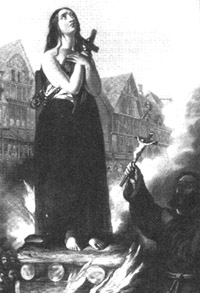
On reading the inscription, one remembers with a shudder that this was the name of the deputy bailiff in Tranent under Lord Seton, afterwards Earl of Winton, who, in the year 1591, was the prime mover in the crusade against witchcraft, which, before it ended, resulted in 17,000 people in Scotland being tortured and burned to ashes for an imaginary crime. David Seton (who probably resided in a quaint old house commonly called the Royal George, which was recently demolished), had a servant maid whose name was Gellie Duncan. She was young and comely, and distinguished for her readiness to attend the sick and infirm, and for her wonderful skill in curing diseases. Seton, being himself destitute of the divine sentiment of compassion, could not understand why any one would take so much trouble to alleviate the sufferings of others, or how a person in a humble station could have acquired a knowledge of leechcraft. He was astounded on hearing the extraordinary cures she had performed, and his base mind was filled with the most preposterous suspicions. He interrogated Gellie as to how and by what means she had learned to treat cases of such importance, and her answers not being satisfactory, he with the assistance of others endeavoured to wring the truth from her by torture. He crushed her fingers in an instrument called the pilliwinkis, or thumb-screws, and that failing he bound and wrenched her head with a cord or rope, which produced excruciating agony. But Gellie remained obdurate and would confess nothing. (Pitcairns' Justiciary Records, vol i.) Then her body was examined and the mark of the Devil found upon her throat. It was believed that Satan put a mark upon all who had enlisted into his service, which mark was recognisable by the part being bloodless and insensible to pain. It is related that Gellie, on the discovery of the mark, made a full and complete confession. She admitted that her attention to the sick had been done at the wicked suggestion of the Devil, and that her cures were effected by witchcraft. She disclosed the names of thirty accomplices, some of them the wives of respectable citizens of Edinburgh, whose conduct had till then been irreproachable. These were all apprehended and lodged in prison. |
|
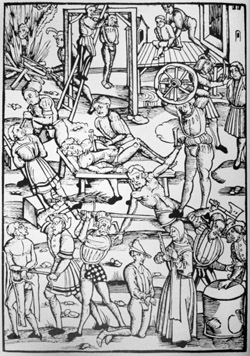
On the 1st of May 1590 James the 6th arrived at Leith after a very stormy passage from Copenhagen, and it had been observed that the ship that carried the King and his young Protestant bride was more furiously buffeted by the tempest than any other vessel in the fleet. Often when the others had fair breezes, she had to contend with contrary winds. This singular circumstance was noticed by many, but none could explain it until the confessions of Gellie Duncan and her accomplices unlocked the mystery. An elderly woman called Agnes Sampson, who lived at Keith, in the parish of Humbie, was one of those whom Gellie informed on. She was arrested and tried before the Court of Justiciary. Amongst other crimes, she was accused of having been assiduous in her attendance on the sick, and of having repeated the creed and the Lord's Prayer in monkish rhyme over them. She denied having any dealings with the Devil, or any knowledge of witchcraft; but on being horribly tortured, stripped naked, and the Devil's mark discovered on her person, she confessed the truth of Gellie Duncans' disclosures. She admitted she was a witch, and related that she had attended a meeting of witches, numbering upwards of two hundred, which was held at the Kirk of North Berwick on Hallowe'en. The Devil presided, and a young man called Cunningham, alias Dr. Fian, acted as Secretary, and an old fellow named Grey Meal, who resided at the Meadow-mill, was the Door-keeper. The meeting had been called to devise a plan for the |
|
destruction of the ship that carried the King and Queen. On this being arranged, the whole crew of witches and wizards set sail in riddles or sieves to meet the Royal Squadron. On the voyage they boarded a ship, and, after helping themselves to meat and drink, sunk her. When the Kings' vessel was sighted the Devil handed a cat to Dr. Fian, and ordered him to throw it into the sea and to cry halo! The cat had been previously drawn nine times across the fire. This being done a tremendous tempest arose, and nothing, but a miracle could have saved the Royal ship from destruction. The Devils' fleet then put about and returned to North Berwick. On reaching the shore the witches marched with their sieves in their hands in a procession to the Kirk, Gellie Duncan tripping in the front and playing a quick-step on the trump or jew's-harp. On reaching the Kirk, they marched three times around it withershins, that is in the direction opposite to the apparent course of the sun, and when they tried to enter the sacred edifice they found the door was locked; but it sprang open when Dr. Fian blew into the keyhole. When the infernal congregation entered the Kirk all was darkness; but the Docter blew in the lights, as other people blow them out, and lo! the Devil was seen standing in the pulpit dressed in a black gown. His first proceeding was to call the Roll. He then enquired whether they had been his faithful servants, and on their answering 'Aye, Maister,' he preached a short sermon with his usual ability. He enjoined them to do all the evil in their power, and promised to take care that they should be handsomely rewarded. At the conclusion of his service, he put his tail over the pulpit and requested them to kiss it, as a token of their allegiance, which they all did. The congregation then retired to the churchyard, where they feasted on the dead, and received joints of human bodies from the Devil, to 'make a charm of powerful trouble.' The convocation was concluded with a dance, to which Gellie Duncan played a reel on the trump, called: 'Cummer, go ye before
Cummer, go ye.' |
|
|
|
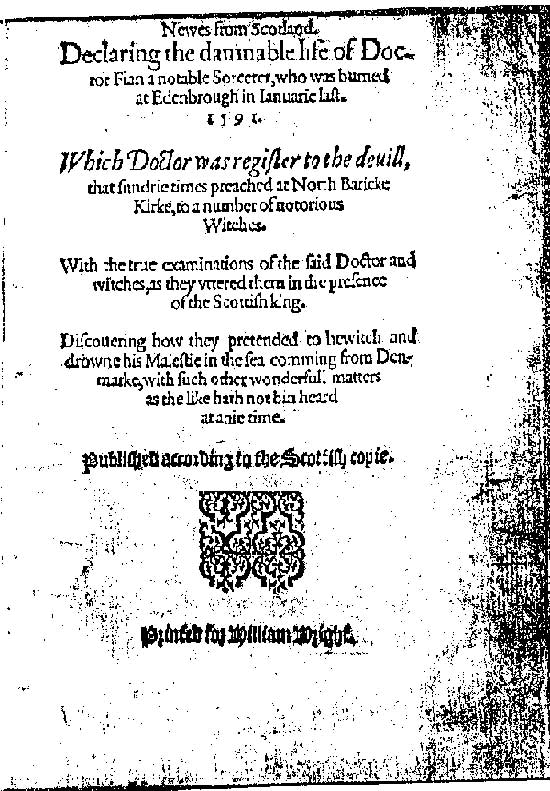
News from Scotland. Declaring the damnable Life of Doctor Fian a notable Sorcerer, who was burned at Edenbrough in Ianuarie last. 1591. ... Published according to the Scottish copie. Printed for William Wright. |
|
Such is the essence of the confessions emitted by these poor wretches under torture, and some have expressed surprise that there should have been such a close agreement between them; but as they were probably all prompted by the prosecution, no surprise need be felt. Cunningham, commonly known as Dr. Fian, was a schoolmaster in Preston, and his superior education would have exposed him to suspicion in those dark days. He was one of those whom Gellie Duncan informed on. He was accused, amongst other things, of having chased a cat in a street in Tranent, and of having leaped a wall as lightly as the cat herself-a wall so lofty that no mortal man, without the help of the Devil, could have cleared it. It was believed that he was collecting cats for Satan, who required a supply for the purpose of raising storms. On being interrogated, Dr. Fian denied that he knew anything of sorcery, and to compel him to confess his guilt he was subjected to the most grevious torments that the mind of man could invent. His legs were put into the bootikens, and crushed with wedges until the blood and marrow spouted out. But he maintained a stubborn silence. In this crippled condition he managed in some way to escape from prison; but unfortunately, returning to Prestonpans, he was again arrested and brought back to Edinburgh. He was again tortured by the bootikens, and in addition his finger nails were torn off with pincers, and pins thrust into the tips of his fingers. But nothing would make him confess his guilt; and finally, he, as well as Gellie Duncan, and the thirty whose names she had in her agony disclosed, were strangled and burned to ashes on the Castlehill of Edinburgh. Some people, ashamed that such atrocities should have been perpetrated in Scotland, when the radiant sun of the Reformation had arisen in the sky, and the dark night of Popery had sunk below the horizon, are willing to believe that although these miserable victims of superstition were innocent of the impossible crimes with which they were charged, yet they were guilty of real crimes which merited all the punishment they received. Fian, it is said, 'was a man who had led an infamous life, was a compounder of and dealer in poisons, and a pretender to magic, and he deserved all the misery he endured.' (Mackays' Popular Delusions, vol. ii., p. 137.) But there is nothing to support the view excepting evidence given under torture, and the ignorant and malignant gossip of the times, both of which ought now to be rejected with indignation. Fian must be held as an innocent man, who suffered the cruelest torments and death at the stake for crimes he never committed, and whose character has been blackened, without a shadow of reason, to this date. The same verdict must be passed on Agnes Sampson, whom the very indictment shows to have been a woman of a pious and benevolent disposition. His Majesty, believing that an attempt had been made on his own life by Satan and his servants, felt a deep interest in these trials, and attended to see the witnesses examined and put to the torture. He sent for Gellie Duncan to Holyrood, and made her play the reel she had performed to the Devil and the witches at North Berwick. 'Cummer go ye before,
Cummer go ye, The trials of the Tranent witches and the extraordinary confessions that had been wrung from them, threw all Scotland into a state of inconceivable excitement. Superstitious terror spread like an epidemic, and James on his accession to the throne of England carried the infection with him. During the first eighty years of the seventeenth century, it has been calculated that 40,000 people were executed for witchcraft there, which added to those judicially murdered in Scotland, makes the fearful total of 57,000 ! It is curious to reflect that it was David Seton of Tranent, whose pigeon house is still to be seen on the Dove-cot Brae there, who struck the spark that caused this appalling explosion of national insanity. Prosecutions for witchcraft had not indeed been unknown before he got Gellie Duncan brought to the stake; but they had been comparatively few and far between. It was his venomous tooth that gave the bite that set the whole pack in Scotland, and in England too, into such a state of outrageous madness, as had never been paralleled before and has never been equalled since. In 1591 the dread and abhorrence of sorcery, fostered by the King, the Privy Council, and the Clergy, grew into a chronic mania which raged without any abatement until the year 1665. During this period a number of cruel villains made witchfinding a trade. They were called 'common-prickers' or witch-finders. One of these scoundrels resided in Tranent, and he must have been a pleasant person for old women to meet at a party. His name was John Kincaid. Although Tranent was his head-quarters, he, accompanied by his man servant, roamed the country in search of employment, and from the skill he was believed to possess in discovering the Devils' mark, he was held in high repute and carried on a prosperous business. His method of testing witches was to stick a brad-awl, or a pin three inches long, into various parts of their bodies, until he found a spot where no pain was felt by the puncture, and no blood came forth, which spot was an infallible sign of guilt. Probably his awl, like the dagger blades of modern jugglers, could be retracted into the hilt when the operator pleased, so as to deceive the eye of spectators. The following certificate (Pitcairns' Justiciary Records, vol 111., p. 602) will give the reader an idea as to the way in which John conducted business: Dalkeith, 17 Junij 1661. The quhilk day Janet Peaston being delaitit as is aforesaid the magistrate and minister caused John Kincaid in Tranent, the common-pricker to prick her, and found two marks upon her which he called the Devill his marks, which apeared indeed to be so, for she did nather find the prein when it was put into any of the said marks nor did they blood when they were taken out again. And quhan she was asked 'Quhair shoe thoght the preins were put in?' Shoe pointed at a part of her body distant from the place quhair the preins were put in they being preins of thrie inches or thairabout in length. Quhilk Johne Kinkaid declaris upon his oath and verifies by his subscription to be true. Witnesses thairto Mr. Wm. Calderwood, Minister at Dalkeith and Williame Scott, Bailzie; Martin Stevinsone and Thomas Calderwood, Elders; Major Archibald Waddell, Johne Hunter, David Douglas. |
|
|
|
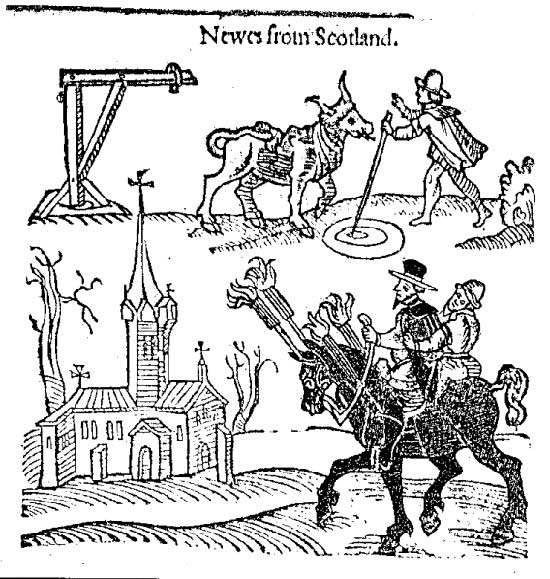
One of Two Woodcuts in William Writes News from Scotland depicting the Witch Hunter |
|
From an account of the expenses of executing a witch named Margaret Denholm at Burncastle, near Lauder, (Hugo Arnot's Criminal Trials, appendix) one ascertains the fee received by Kincaid. He was paid six pounds Scots 'for brodding of her' besides 'meat and drink and wyne to him and his man' which cost four pounds-total ten pounds Scots, whilst the hangman of Haddington received nine pounds, fourteen shillings Scots, which included charge for 'meit and drink and wyne for his intertinge' and travelling expenses-a man with a led horse having been sent for him. Two men, who watched the woman for a month, were paid forty-five pounds. Probably their duty was to prevent the witch from falling asleep, which experience had proved to be an unendurable torture, and an excellent method of forcing a confession. Iron collars, with spikes turned inwards, which could be tightened with a strap, were sometimes used for the same purpose. Margaret Denholm possessed enough property to defray the expense of her execution, and to leave a balance of sixty-five pounds Scots. Where John Kincaid was born, and where, when, or in what manner he died, I have as yet been unable to discover ; but have read somewhere that he got into trouble at last by wishing to search for the Devils' mark on a lady of quality. Ministers of the Gospel, Presbyterian as well as Episcopalian, were the firmest believers in witchcraft, and the most pitiless and active persecutors of the miserable wretches who were suspected of that imaginary crime. The Rev. Allan Logan, Minister of Torryburn, Fife, in 1709 often preached a sermon against it. He prided himself on his penetration in detecting witches, and on one occasion he cried out, 'You witch-wife, get up from the Lord's table.' The last execution for witchcraft which occurred in Scotland, took place in Sutherlandshire in 1722, when an old woman was accused of having transformed her daughter into a pony, of having got her shod by the Devil, and of have ridden upon her back. Her daughter was said to have been crippled in her hands and feet in consequence, an injury that was entailed upon her son. Weakened in mind by the misery she had suffered, the poor old woman, it is related, sat warming herself, the weather being cold, in perfect composure at the fire which had been kindled to consume her. She was burned at the stake at Dornoch. It is worthy of mention that when a bill for the repeal of the Act against Witchcraft was introduced into Parliament in 1735, it was opposed by Lord Grange, whose estate of Prestongrange is near Tranent. He was a judge of the Court of Session, and is 'damned to everlasting fame' chiefly for having, through the instrumentality of Fraser of Lovat, and MacLeod of MacLeod, sent his wife to St. Kilda, where she resided in what to her must been great misery for the period of seven years. She must have been on that lonely island when her brutal husband opposed the bill for the repeal of the Act referred to.
'Winsome wench and waly, |
Acknowledgements:Sketches of Tranent in Old Times 1881 by J Sands Chapter 3 Picture Pamphlet Imges - Newes from Scotland. Declaring the damnable Life of Doctor Fian a notable Sorcerer, who was burned at Edenbrough in Ianuarie last. 1591. ... Published according to the Scottish copie. Printed for William Wright. © Edward H Thomson University of Dundee. Adaptation of Article by John A. Duncan of Sketraw KCN, FSA Scot. |
|