| |
| |
|
Dr Handasyde Duncan
1811 - 1878 |
|
by J B Cleland |
|
|
|
DUNCAN, HANDASYDE
(1811-1878), medical practitioner, was born on 13 November 1811 at Glasgow,
Scotland, the son of Andrew Duncan and his wife Jane, née Morison. His
father's firm printed and published for the university. Duncan was educated
at Glasgow High School and the Universities of Edinburgh (L.R.C.S., 1829)
and Glasgow (M.D., 1831). He travelled in France and Germany where he learnt
the use of the stethoscope, and then settled at Bath where he married Kate,
elder daughter of Dr William Bowie. Deciding to emigrate for health reasons
he sailed as surgeon in the Katherine Stewart Forbes, and arrived in
Adelaide in 1839. He had bought a land order in England and near the River
Sturt he selected eighty acres (32 ha) which he called Eldon. It remained
his home for six years, but his farming venture was unsuccessful. In
November 1841 he was gazetted consulting physician and surgeon to the new
Adelaide Hospital. He was an original member of the Medical Board of South
Australia appointed in 1844, and served on it until his death; his name was
third of the original seven on its medical register. In 1845 he applied for
the position of resident medical officer at the Burra mines and, when
rejected, he set up in practice at Port Adelaide. |
|
Although brought up in a
rigid Presbyterian tradition, Duncan became a convinced and enthusiastic
Anglican. In Adelaide he attended Trinity Church and became a close friend
of the colonial chaplain, Rev. Charles Howard and his successor, Rev. J.
Farrell. At Port Adelaide he became a leading light at St Paul's and later
its representative in synod. In 1846 he joined the committee of the church
society that allocated the Anglican share of state aid to religion, and he
was appointed by Lieutenant-Governor Frederick Robe a member of the first
South Australian board of education. He was also active in establishing the
Collegiate School of St Peter. In August 1849 he was appointed health
officer and assistant colonial surgeon at Port Adelaide, and a month later
immigration agent. Next year his vigorous views on education and state aid
to churches, together with appeals for colonial investment and emigration to
a healthy climate, appeared in his The Colony of South Australia (London,
1850). His severe criticism of the quality of new immigrants in 1851-55
brought strong reproaches from the land and emigration commissioners in
London, but his undaunted answers won the day. In 1853 he became a Freemason
and was later worshipful master of the Lodge of Unity at Port Adelaide.
Duncan's wife died on 8
August 1854 after a fall from a horse. Soon afterwards he married Anne,
daughter of Captain Richard Williams. |
| |
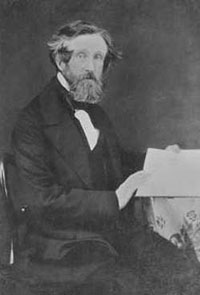
Handasyde Duncan (1811
- 1878), by unknown photographer, c1856, courtesy of State Library of
South Australia. SLSA: B7821 |
|
|
She died in child-birth on
21 January 1861 leaving him with three young children. On 8 August 1867 he
married Emily Susan, eldest daughter of Commander F. Servante of Dashwood
Gully. After her death in childbirth in 1870 his sixteen-year-old daughter
Annie took charge of his household and cared for her father in his declining
years. Duncan died at his home at Port Adelaide on 24 February 1878.
Duncan's second daughter, Mary Celia, married Rev. A. R. Champion, and his
son, Andrew Henry, after a long naval service became acting administrator of
Rhodesia during the Matabele rising in 1896; he died in Pretoria in 1931.
Duncan had many interests outside his profession. As a classical scholar, he
made a translation of Herodotus. He read widely, had a good memory and was
much given to long recitations. His daughter Annie gave a pleasing account
of him as a man of scrupulous rectitude, extremely punctilious, yet
warm-hearted and full of vivacity, fun and laughter. |
| |
Acknowledgements:
J. B. Cleland, 'Duncan, Handasyde (1811
- 1878)', Australian Dictionary of Biography, Volume 1, Melbourne University
Press, 1966, p. 335.
|
|
|
|