| |
|
David Duncan
the Albion Hermit |
| |
David Duncan (1810-1868),
the “Albion Hermit.” Lived a recluse life on 80 acres of land which
was located near the Kalamazoo River,
south of where the Caring Community Church is located today on Irwin Avenue.
“Dunk’s Cove” is the name for the big curve in the Kalamazoo River a mile
west of Riverside Cemetery, for it was near this site that “Old Dunk” made
his abode. |
|
| |
This month marks the anniversary of his
death, when he was found on March 6, 1868. Duncan had come to Albion in the
spring of 1835 from New York. He came here as a peddler of goods which he
had purchased at an auction of merchandise damaged by a fire in New York in
December, 1834. He ran out of merchandise and subsequently purchased his
land from the U.S. government.
Duncan began to act queerly, and Alienates
wondered about the background of this man. One source wrote shortly after
his death in 1868, “What caused him to live in this manner has always been a
mystery here. It was supposed by some that he was disappointed in love and
by some that he had committed crime and had chosen a life of seclusion to
shun detection. Every effort to trace his nativity always proved
unsuccessful. So he has lived worse than a brute and died equally as bad.”
Duncan first dug a hole in
the side of the earth on his land where he lived for ten years. In 1847 he
erected a small frame house which he never finished. A family by the name of
Smagg was said to have lived with him for about six months. He lived alone
for many years, growing vegetables and raising cattle which he took to
market. |
|
 |
|
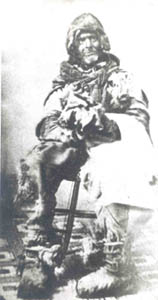
David Duncan |
|
|
| |
Dr. Elmore Palmer wrote in 1908,
“Everything clearly indicated that he never washed himself or his rags.
Filth in the greatest amount and odours the rankest of the foul are still
perceptible to the writer’s olfactories.”
A “John C. S.” wrote in 1868, “He now
began to dress more shabbily and grow more miserly until he was really a
sight to behold. For the past eight or ten years his dress has actually
consisted of bags sewed about his body. In the cold season he wore an ox
hide with a hole cut in the middle to insert his head for a supposed
overcoat. A portion of a bag and a piece cut from the hide was sewed
together for a cap, and boxes made of oak boards about 6 X 15 inches with
half a bag nailed around the top served for boots.” That writer mentioned he
had retrieved one of Dunk’s wooden boots upon his death and found that it
weighed eight and a half pounds. |
|
| |
|
 |
|
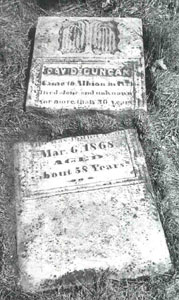
Dunk's Tombstone |
|
In early March 1868, a winter storm hit
the area. A Mr. Perrine went to visit Duncan, and found him frozen to death,
sitting on the floor against his fireplace, covered with snow. Perrine
hurried back to Albion where he contacted Fitz Williams, who organized a
group of men which included the Coroner, Dr. Willoughby O’Donoughue.
The group found that “Old Dunk” had $11.18
in his pocketbook, some corn and cornmeal upon which he fed during his last
days, and some old sales receipts from 1834 when he had lived in New York.
The body was taken to the Albion Fire House, located in downtown Albion,
presently 113 S. Superior St. His body was placed in a large tub of water to
thaw out. An inquest jury determined that Duncan must have been sick and
died of natural causes. One witness stated, “After the clothes were soaked
off, the skin actually looked like a scurvy hog and as the frost came out
the dirt would crack off in chunks.”
Duncan had kept his money in the National
Exchange Bank of Albion, then located on the southwest corner of S. Superior
and W. Porter Sts. With his funds in the bank and the $11.18 cash, a
cemetery lot |
|
| |
and a coffin was
purchased for him. Services were held at the fire hall on the Sunday
following the discovery of his death. The First Baptist Church minister,
the Rev. P. Van Winkle delivered the eulogy. The remainder of the funds in
his estate were used to purchase a tombstone.
During the early 20th
century Duncan’s tombstone was cracked in half and lay unkept. In 1947 the
staff of the Albion Recorder was notified of this and paid to have “Old
Dunk’s” tombstone encased in cement foundation where it remains today.
Thus the mystery has been solved: It was the Albion Recorder which had
“Old Dunk’s” tombstone encased in cement in Riverside Cemetery.
Larger images Can be
Found in the Gallery:
Tombstone and
David Duncan |
|
|
|
|
