| |
| |
There is no question that
Dunchad (Duncan) is one of the earliest of names in Northern Britain and
what historical records there are of pre medieval Scotland are scarce. Those
fragments that we do have in our possession today are, for the most part,
those writings in Gaelic of the Celtic Scots monks starting with their
arrival on Iona from Ireland. |
|
| |
|
 |
|
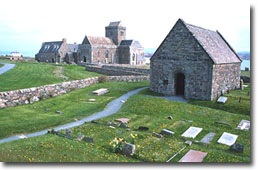
The Abbey of St Orans,
Iona |
|
Iona is most anciently known as
Ioua, its ancient Gaelic or Pictish name. This is the name
invariably used by Adamnán, the ninth abbot, writing at the end of the
seventh century. In modern Gaelic it is called “I” (pronounced
ee), which simple form means
island. In the fifth
century the Druids are supposed to have come here to escape the persecution
of imperial Rome, and to have founded a library on the island. In 410, when
Fergus II became an ally of Alaric the Goth, he added to that library by
bringing back books from the plunder of
Rome.
So it was an established place of learning well before Columba arrived!
Another name for the island is Innis
nam Druineach, meaning the Island of the Cunning Workmen,
|
|
| |
or sculptors; and
still another is Innis-nam-Druidneach,
the Isle of Druids.
More than twenty
years before Columba came to Iona, a Christian cemetery was founded on the
island by St Oran of Letteragh, who died in 548. This
Reilig Odhrain
(St Orans Shrine) was the burial place of the kings of Dalriada up to 560,
three years before Columba's arrival with his twelve followers.
There is |
|
| |
also a
tradition that there
was a college of seven bishops on the island at one time; and that two of
them met Columba when he arrived from Ireland and did their best to
persuade him not to land. Bishops in the ancient church had no territorial
or diocesan powers and were subject to the authority of the ab (the old
term for abbot) of the community where they were living at the time. They
were simply required to provide episcopal functions such as ordination.
Many of the community would not be ordained and they did not dedicate
their churches in the modern sense, so the bishops were much limited in
their functions.
It is here on Iona that
we find one of the earliest mention of Dunchad (Duncan) the 11th
Abbot of Iona 707 – 717AD
'St.
Dunchadh (Dumhade, Dumhaid, Dunchad), Abbot of Iona. Died March 24, 717.
Dunchadh was born into the line of Conall Gulban. He became a monk at
Killochuir in southeast Ulster and, from 710 until his death, ruled the
abbey of Iona, Scotland. During Dunchadh's abbacy, Saint Egbert (f.d.
April 24) finally convinced the Celtic monks of Iona to adopt the Roman
customs - tonsure, date of Easter, Benedictine Rule. For Saint Bede
this was the final sign of unity from diversity, which was the main theme
of his "Ecclesiastical History." Dunchadh is the titular saint of
Killclocair, in the diocese of Armagh. His feast is still celebrated in
Donegal on May 25; elsewhere it is March 24. He is the patron of sailors
in Ireland' |
|
 |
|
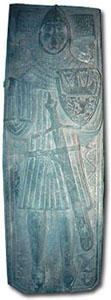
A lord of the Isle |
|
|
| |
and again with Dunchad
(Duncan) the 39th Abbot in 989AD.
Iona is also the burial Place of the ‘Kings of Scotland’ and
the ‘The lords of The Isles’ and it is here that
Dunchad mac Conaing (650 - 654AD),
Duncan I (1034 – 1040AD) and
Duncan II (1093- 1094AD) are interned.
By John A. Duncan of Sketraw, KCN, FSA
Scot.
|
|
|
|
|

