| |
| |
|
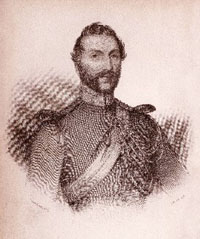
John Duncan African Explorer 1804 -
1849 |
|
by Derek O'Conner |
|
|
|
Until now John Duncan has
been the “lost” explorer, the man who risked his life to investigate
Africa’s secrets, only to have his accomplishments and the book he wrote
forgotten by a fickle public and an ungrateful society of geographers.
His unlikely story began in 1804 when Duncan was born in Kirkcudbright,
Galloway, Scotland. Because his parents were inconspicuous farmers, Duncan
received a modest education. Yet his natural intelligence, matched with his
exceptional height and great strength, allowed him to enlist in the elite
Life Guards cavalry in 1824. For the next sixteen years Duncan toiled
quietly at his military duties. |
|
Then in 1841 he was
recruited to act as master-at-arms aboard HMS Albert, the flagship of the
1841 Niger steamship expedition. Of the 145 Europeans who started up the
Niger 53 perished, and Duncan nearly lost his life, too.
Undeterred, Duncan returned to West Africa again in 1844 in search of the
legendary Kong Mountains. This time he was the master of his own fate thanks
to a small subsidy allotted to him by the Royal Geographical Society.
Yet his solo expedition soon ran out of funds and into trouble, forcing the
stranded traveller to seek assistance from the notorious warrior King Gezo.
The ruler of the
militaristic state of Dahomey, Gezo’s very name was a byword for unbridled
cruelty. One of the most peculiar meetings in African exploration history
occurred when Duncan, the towering cavalryman attired in the magnificent
uniform of the Life Guards, was honoured by King Gezo, the charismatic
native leader. Together they drank toasts to Queen Victoria from
|
| |
John Duncan African
Explorer |
|
|
goblets carved out of human
skulls and discussed Duncan’s quest to explore further inland. The meeting
concluded with Duncan not only receiving aid fromthe king but also being
honoured by Gezo with the protective title of “King’s Stranger.”
Although Duncan never found the elusive Kong Mountains, he did become the
first European to explore a vast tract of uncharted West Africa, marching
through swamps while hostile tribesmen dogged his footsteps and making
important observations regarding the mounted African cavalry culture which
flourished further inland. After incredible hardships and adventures he came
perilously close to death yet again.
Physically exhausted, he returned to England in May, 1846 to something less
than a hero’s welcome. The government disdained his information and the
Royal Geographical Society bestowed only grudging praise on Duncan’s book,
Travels in Western Africa in 1845 and 1846; this despite the fact that
Duncan had uncovered eyewitness evidence regarding the murder of Mungo Park,
as well as having made a series of valuable observations in the field. Yet
due to his humble birth, the academically exclusive London establishment was
quick to disdain the accomplishments of this determined man.
Duncan’s last visit to West Africa was in 1849. Appointed British vice
consul to Dahomey, the cavalryman turned diplomat was given the difficult
task of securing King Gezo’s assent to an anti-slavery treaty. In an effort
to convince the wily ruler to cooperate, the indomitable but ailing Scot
made two further gruelling journeys into the interior before death finally
claimed him in November, 1849.
For all his courage, physical strength and amazing exploits, John Duncan was
ultimately a tragic figure. Forgotten by history, disdained by the Royal
Geographical Society and ignored by the British Government, Duncan’s
achievements were quickly overshadowed by the titans of African exploration
who followed him, notably his fellow Scot Dr. David Livingstone, Richard
Burton and Henry Morton Stanley. |
| |
Acknowledgements:
From the book 'The Kings
Stranger' by Author Derek O'Conner - ISBN 1590482417 |
|
|
|