| |
|
Heraldic
Heritage in Monuments |
|
by John A. Duncan of
Sketraw, KCN, FSA Scot. |
|
| |
|
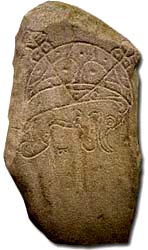 |
|
1st millennium
Pictish stone |
|
It might be said that something in the way of Monumental
Heraldry started in northern Britain in the later part of the first
millennium BC with the aboriginal Picts - whose name is actually a Roman
invention from the late third century AD. With the Z rods, moons, deer,
elephant, salmon, cauldrons, mirrors and combs, ravens, axes and horses etc.
that they cut into standing
stones and monoliths, these ‘iron age’ Picts give us our first true glimpse
of the use of monumental symbolism in northern Britain. Without a great deal
more information, from other sources that are unlikely to have survived, it
isn't possible to say that these inscriptions were hereditary or organized
in ways analogous to heraldry in later centuries, but it is probably safe to
say that they were used in many of the same ways: to mark out territorial
ownership, as personal statements of identity, or as group markers of tribal
identity (though perhaps in not quite the same way as a modern clan member's
badge!) |
|
| |
By 503AD
the Celtic Scots had entered northern Britain from the west and had begun to
introduce Christianity to the aboriginal Picts. From this time on new forms
of symbolism - griffins, dragons, knot work, vines, trees, all sorts of
beasts and mythical creatures - began to be cut into new forms of monuments
- monumental stone crosses and grave slabs, perhaps for much the same
reasons that similar things were decorated heraldically in later centuries.
The
defeat of the Pict’s in 841AD by the Scots Celts and the unification of the
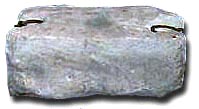
two peoples under Kenneth MacAlpin in 843AD saw the the ‘Stone of Destiny’,
the symbolic and metaphoric seat of power of the Celtic Dalriadic Kings,
moved to Scone in the old Pictish kingdom, which was to become the centre of
government, a real seat of power in Scotland with the birth of a Scottish
nation of diverse peoples – a nation which continued to be diverse in its
origins and traditions, as the heraldry of later centuries records. |
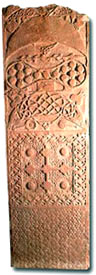 |
| 2nd
Millennium Pictish Stone |
| showing the
Celtic Religious |
| Influence-
reverse Celtic Cross |
|
|
| |
|
 |
|
The 'Stone of Destiny' |
|
Although there is no definite and clear start date for heraldry as we know
it today in Scotland, it had certainly been established by the later part of
the 12th century and although growing in use, as can be seen from
12th century seals, that growth and development was sadly poorly
documented in the remains that have come down to us. |
|
| |
Within a century or so of the
establishment of heraldry in Scotland the long
struggle against English imperialism had begun with the invasion under
England's Edward II and the start of the Wars of Independence. Things were
to calm down for a while with victory at Stirling Bridge, but it took eight
years of struggle from the crowning of Robert Bruce in 1306 until English
military occupation was definitively ended at Bannockburn.
Whatever
heraldic records there were in those times, whether in Scotland or stolen
away by the former occupying power, have long since vanished and all we are
left with are the seals and monuments. And this, unfortunately, remains true
of Scots heraldry through medieval, Renaissance and Reformation times, as
much of the written and painted record has either gone in the flames of
unfortunate fires or was stolen away in a later English military occupation,
the one of the 1650s.
But
although we lack the written and painted records, what we do have, as we
have for the Picts, is the records of the monument in stone and, which we
don't have for the Picts, the carvings in the much more perishable medium of
wood. |
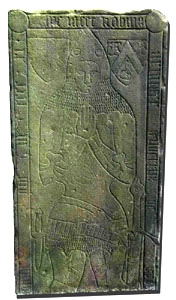 |
| Gilbet de Greenlaw |
| Killed in the battle of
Harlaw 1411 |
|
|
| |
|
 |
|
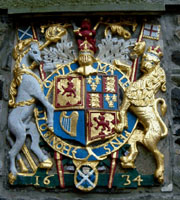
Arms of Charles I - 1634, Banff |
|
|
|
|
