| |
| |
|
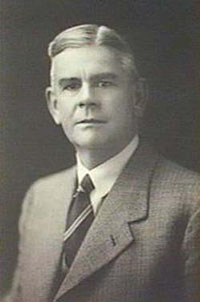
Sir Walter Gordon
Duncan 1885 - 1963 |
|
by Jenny Tilby Stock |
|
|
|
DUNCAN, Sir WALTER GORDON
(1885-1963), pastoralist and politician, was born on 10 March 1885 at Hughes
Park, near Watervale, South Australia, third of six children of
(Sir) John James Duncan, a
Scottish-born pastoralist and politician, and his second wife Jean Gordon,
née Grant, from England. The family derived its considerable wealth from the
pastoral and mining activities of John's father Captain John Duncan and
maternal uncle Sir Walter Watson Hughes. Young Walter was educated at
Cheltenham College, Gloucester, England (1897-98), and at the Collegiate
School of St Peter, Adelaide. Athletically rather than academically
inclined, he captained the school cricket team in his final year and
maintained a passion for the game, along with riding, racing and golf. |
|
Leaving school in 1903,
Duncan worked at Hughes Park, and on other family properties—Gum Creek, near
Burra, and Manunda in the saltbush country near Yunta. On 20 October 1909 at
Chalmers Church, North Terrace, Adelaide, he married with Presbyterian forms
Bessie Graham Fotheringham; they lived at Parkside and were to have three
children. He became part-owner of several properties, a director of the Milo
and Bon-Bon pastoral companies, and chairman of directors of Manunda
Pastoral Co. Ltd. As the result of a family decision in 1914, Walter—the
only son with young children—remained in South Australia in charge of the
Duncan concerns while his mother accompanied her three other sons to England
where they joined the British armed services. In 1918, as a Coalitionist,
Walter was returned to the Legislative Council as a member for Midland, the
district which his father had represented in 1900-13. Ability, and an
electoral system that favoured rural property owners, kept him there for
forty-four years.
An astute, practical and likeable man, Duncan emerged as a major figure in
the State's commercial, agricultural and political life. He was a director
(1922-62) of Broken Hill Proprietary Co. Ltd and, with Harold Darling, was
one of Essington Lewis's closest friends; all three crossed the continent
from Adelaide to Darwin by train and car in 1924. Duncan also enjoyed
overseas travel: he visited Britain and Europe with his
wife in 1926, and i nspectedsteel-mills in |
| |
Sir Walter Gordon
Duncan (1885 - 1963), by Hammer & Co., courtesy of State Library of South
Australia. SLSA: |
|
|
India with Lewis in
1938-39. South Australia's industrial development at Whyalla owed much to
Duncan's influence in B.H.P. and Australian Iron & Steel Pty Ltd. He chaired
the board of Bagot's Executor & Trustee Co. Ltd (1921-54), and the Adelaide
boards of the Australian Mutual Provident Society and Goldsbrough Mort & Co.
Ltd, and was a director of the Adelaide Steamship Co. Ltd (1932-60) and of
Wallaroo-Mount Lyell Fertilisers Ltd. During World War II he was chairman of
the State's Business Administration Committee, which was established to
investigate allegations of wastage and which reported to the Department of
Defence Co-ordination, Melbourne.
A source of personal and
professional satisfaction to Duncan was his long association with the Royal
Agricultural and Horticultural Society of South Australia. As president in
1924-25 (and also in 1932-50) he oversaw the move from North Terrace to the
Wayville showgrounds; much of the new venture's success was due to his
efforts. In 1939 he was knighted. He was president of the Stockowners'
Association of South Australia and an honorary member (1943) of the Royal
Agricultural Society of England. An exhibition hall bearing his name was
opened at the Wayville showgrounds in 1962.
For four decades Duncan influenced non-Labor politics. Heeding his father's
advice that more power could be exercised 'as an outside member' of the
council, he did not seek ministerial office or a seat in the House of
Assembly. While Liberal Federation president (1930-32), he kept the Hill
Labor government in office to implement the Premiers' Plan. Duncan also
helped to recruit (Sir) Archibald Grenfell Price as organizer of the
'non-party' Emergency Committee of South Australia which neutralized the
Citizens' League and delivered a united conservative vote (and six of South
Australia's seven Federal seats) to the Lyons government in 1932. Duncan was
one of the Liberals who ended fourteen years of feuding with the State
Country Party by negotiating a merger which formed the Liberal and Country
League in June.
A member of the South Australian gentry, and of the Adelaide (from 1914) and
Australian clubs, Sir Walter led the council in 1932-44, defended States
rights and was deeply suspicious of any suggestion of socialism. He fought
Lyons's 1937 referendum on marketing, and favoured big merchants over small
farmers in the protracted debates on bulk-handling and wheat-pooling. His
opposition spelt defeat in 1938 for Premier (Sir) Richard Layton Butler's
voluntary equalization scheme for the depressed dairy industry. Yet, Duncan
was not averse to government assistance for projects endorsed by trusted
business associates or deemed to be for the greater good, like Whyalla,
Cellulose (Australia) Ltd and the South Australian Housing Trust. He and his
friend the premier (Sir) Thomas Playford each valued the other's common
sense and pragmatism.
As president (1944-62) of the Legislative Council Duncan was fair minded,
good humoured and prepared to bend the rules to expedite proceedings. He won
both popularity and respect. With severely parted grey hair and eyes that
twinkled behind heavy horn-rimmed glasses, he wore a spotted bow-tie and
smoked a large-bowled pipe. He retired due to age and increasing deafness in
1962. His last years were shadowed by the death of a daughter, Bessie's ill
health and his own battle with cancer. Survived by his wife, son and a
daughter, he died on 27 August 1963 at Parkside and was cremated. His estate
was sworn for probate at £125,617. G. A. Thorley's portrait of Duncan is
held by the Legislative Council. |
| |
Acknowledgements:
Jenny Tilby Stock, 'Duncan, Sir Walter
Gordon (1885 - 1963)', Australian Dictionary of Biography, Volume 14,
Melbourne University Press, 1996, pp 52-53.
|
|
|
|