| |
|
Clan Recognition and The
Derbhfine
|
|
In order for the Clan
Duncan Society to have a chief and clan
officially recognised by The Court of the
Lord Lyon, Scotland there are certain
criteria that we need to meet;
a.)
Find a Duncan with a proven genealogical paper
chase back to the 3rd Duncan Chief, around 1392,
a near impossible task.
b.)
Create a derbhfine,
which would be the most likely scenario. A
Derbhfine is a meeting of 9 or more Scottish
Duncan armigers (a person who has a Grant of a
Coat of Arms (Scotland) or Duncans who have
significant Land owners in Scotland. They would
in the first instance elect a Commander of the
Clan. This Commander after a period of time
would then be considered by the Lord Lyon to be
Chief of the Clan. See Lyon Court Guidelines for the holding
of a derbhfine meeting for more
information.
c.)
Clan Roll-Call and Society Membership. The 'Clan Roll-Call' are
those Duncans and spelling variants who support
the creation of an independent clan with their
own clan chief. 'Clan
Society Membership' are those members who
support the Society financially, become officers
of the Society, promote the Society Nationally
and Internationally and generally work towards
the goals laid down in the 'Society's
Constitution'.
Heraldry
plays an important role in the formation a Clan and we
encourage Duncans and those with alternative
spellings to petition Lord Lyon for a Grant of
Arms. Obtaining a grant of arms not only helps
the Clan Society but on a personal level writes
you and your heirs into the history of Scotland.
When a grant, or matriculation, of Arms is
obtained, an illuminated parchment, narrating
the pedigree as proved, is supplied to the
Petitioner, and a duplicate is recorded in the Public
Register of All Arms and Bearings in Scotland.
To
petition for a Scottish Coat of Arms you do not
need to be domiciled in Scotland but you have to
come under the Court of the Lord Lyon's
jurisdiction; please see Acquisition of
Grant and Matriculation of Scottish Arms
for non British Subjects.
The
Clan Duncan Society can assist members with the
process of petitioning for a grant of arms, arms
design and the necessary documentation required
for presentation of the petition to Lord Lyon
King of Arms for his consideration. Help in the
process can be obtained either through the society forum, or
directly by contacting the
society. Alternatively you could gain help via The Society
of Scottish Armigers (North America), The
Heraldry Society of Scotland or contact
the Court of
the Lord Lyon direct by letter or phone.
|
|
History and The Court of the Lord Lyon.
The
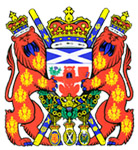
Court of the Lord Lyon is the heraldic authority
for Scotland. It deals with all matters relating
to Scottish Heraldry and Coats of Arms and
maintains the Scottish Public Registers of Arms
and Genealogies. The Lord Lyon King of Arms is
also responsible for State Ceremonial in
Scotland.
The
office of Lyon King of Arms dates from the 14th
century. The earliest official record is of the
appointment of a Lyon by King Robert the
Bruce in 1318, but the office may be
|
|
|
older.
The position incorporates the ancient Celtic
office of High Sennachie who was responsible for
verifying the genealogy of the King of Scotland
and for crowning the King at his coronation.
The
Lord Lyon is the sole King of Arms in Scotland.
He is Head of the Heraldic Executive and the
Judge of the Court of the Lord Lyon which has
jurisdiction over all heraldic business in
Scotland.
He
is assisted by Her Majesty's Officers of Arms,
all of whom are members of the Royal Household.
There are three senior Officers of Arms (Albany
Herald, Rothesay Herald and Ross Herald) and
three junior Officers of Arms (Unicorn
Pursuivant, Carrick Pursuivant and Bute
Pursuivant).
The Officers of Arms may be consulted on matters
of heraldry and genealogy by members of the
public and may represent their clients before
the Lyon Court. The Officers of Arms also take
part in ceremonial occasions.
An Act of the Scottish Parliament of 1592 gave
the Lord Lyon responsibility for prosecuting as
a criminal offence anyone who uses unauthorised
Arms. The Court has its own Procurator Fiscal,
an independent official prosecutor.
In 1672 a further Act of the Scottish Parliament
authorised the creation of the Public Register
of All Arms and Bearings in Scotland. This
Register is maintained by the Lyon Clerk and
Keeper of the Records and contains an official
copy of every Coat of Arms granted in Scotland
since 1672.
Back to top>
|
|
What is a clan? -
From the Court of the Lord Lyon
The
clan system is closely bound up with Scottish
heraldry. The best definition of a clan provided
by a heraldic authority is contained in Nisbet's
"System of Heraldry", published in 1722: ‘A
social group consisting of an aggregate of
distinct erected families actually descended, or
accepting themselves as descendants of a common
ancestor, and which has been received by the
Sovereign through its Supreme Officer of Honour,
the Lord Lyon, as an honourable community
whereof all of the members on establishing right
to, or receiving fresh grants of, personal
hereditary nobility will be awarded arms as
determinate or indeterminate cadets both as may
be of the chief family of the clan.’
A clan is therefore a community which is both
distinguished by heraldry and recognised by the
Sovereign. At the head of this honourable
community is the chief. He is the only person
entitled to display the undifferenced shield of
Arms, ie without any marks of dependency upon
any other noble house.
Chiefship is a title of honour and dignity
within the nobility of Scotland. Any claimant to
such a title must establish, to the satisfaction
of the Lord Lyon representing the Sovereign,
that he or she is entitled to the undifferenced
arms of the community over which they seek to
preside. It is the determining of chiefship
which is among the Lyon Court's central work.
Many of the cases which have come before the
Lyon Court in the last 50 years have related to
the chiefships of clans. There are now about 140
clans that have chiefs recognised by the Lord
Lyon.
A clan or family. which has a recognised chief
or head confers noble status on the clan or
family which gives it a legally recognised
status and a corporate identity. A family or
name group which has no recognised chief has no
official position under the law of Scotland.
Back to top>
|
|
Lyon Court
Guidelines for the holding of a derbhfine
meeting
There are generally five circumstances in which
a meeting of the derbhfine might take place.
(1) Where the appointment of a Clan Commander is
sought.
(2) Where a blood link to a past Chief is very
likely but is not conclusively proved and it is
wished to propose a particular person to be
confirmed as Chief.
(3) Where the main line of descent from a past
Chief has died out and it is wished to confirm
the Representer of another line as Chief.
(4) Where no identifiable descendant from the
last known Chief can be found and it is wished
to propose a particular person to be confirmed
as Chief
(5) Where a "clan" which has never had a Chief
seeks the appointment of a "Chief'.
Various factors need to be considered in
relation to each of these. In the case of (1)
the genealogy of the applicant is not
particularly relevant. What is important is that
the applicant has the support of the clan.
In the case of (2) and (3) it is more likely
that there will not be a derbhfine but that Lyon
will be asked to confirm the applicant as Chief
for aught yet seen, but the clan may wish the
derbhfine to meet. It is important that there
should be no known likelihood of a competing
claim.
In the cases of (2), (3) and (4) it is important
that there should be general support from the
members of the clan and also that sufficient
time has been allowed for any competing claims
to emerge and to be dealt with.
In the case of (5) there is also the question of
whether the group should be accorded the status
of a clan.
Historical position
Two factors have applied in the past. Firstly
there has been a rule of thumb that a 20 year
period should elapse between the appointment of
a Commander and the meeting of the derbhfine to
consider a proposal for a Chief. Secondly the
traditional function of a meeting of the
derbhfine is a forum to discuss what to do
rather than to consider a specific proposal.
Both of these factors require further
consideration.
The 20 year period between the appointment of a
Commander and a proposal for Chief has not
always been applied in the past but has been
frequently referred to in discussions with
applicants. Many existing Commanders understand
it to apply to them. Twenty years seems a very
long time in an age of rapid communication. Five
years is probably too short to allow a Commander
to establish himself, get an organisation going,
make himself known to clan members worldwide and
allow clan members to judge whether the
Commander is the right person for the job. But
10 years should be sufficient time for all this
to happen. Twenty years seems unreasonably long.
It will be important, if an application is made
for a Commander to be considered for Chief, to
know what activities the Commander has
undertaken since his appointment and whether
there is any dissatisfaction with him as well as
whether any alternative candidate may have
emerged. In judging whether the members of the
clan are satisfied it will be important to bear
in mind that in a number of cases the Commander
may have pushed himself forward and may have
discouraged other candidates from coming forward
as alternatives.
The traditional role of a meeting of the
derbhfine as a forum for general discussion is
probably now out of date. At a time when most
clan members would have been in Scotland, would
have known a large proportion of their kinsmen
and would have found it relatively easy to meet
together, it made sense to consider calling the
principal men in a clan together for a general
discussion. But now that clan members are
scattered all over the world, exist often in
substantial numbers and know only relatively few
of their kinsmen, it is difficult for members of
the derbhfine to be confident that they know the
wishes of the clan members in general. It is
also unreasonable to expect people to travel
from distant parts of the world to a clan
meeting without their being given a clear idea
of why they are being asked to attend and it is
desirable for those who are unable to attend to
be able to make their views known. It therefore
seems sensible for the role of a meeting of the
derbhfine to change to one which has a specific
clear purpose and also for a means to be
provided for those unable to attend to make
known their views.
Procedure to be followed in future
(1) In future there will normally be a minimum
period of 10 years between the appointment of a
Commander and an application for a person to be
considered for Chief. A Commander will normally
be appointed for a 5 year period and
re-appointment for a further 5 years will be
considered by Lyon without any further derbhfine
being required. Where a 20 year period has been
either set down or advised in the past, this
will no longer apply.
(2) The following rules must be observed in the
conduct of any meeting of the derbhfine. These
are designed to ensure that members of a clan
generally are aware of what is proposed and have
an opportunity to make their views known.
(i) One of HM Officers of Arms, or a person
approved by Lyon, must be appointed to supervise
the meeting of the derbhfine. This must be
arranged before any notice under (iv) below. The
fee charged by the supervising officer will be a
matter for the clan.
(ii) The supervising officer's role is to act as
an impartial Chairman and to make an objective
report to Lyon.
(iii) The members of the derbhfine will be as
provided for in Lyon's 1992 Rules a copy of
which is annexed. However these new Rules will
also provide a means whereby non-armigerous and
non-landed clan members can express their views.
The supervising officer and the derbhfine will
be made aware of these views but the derbhfine
will not be bound by them.
(iv) Notice of any meeting of the derbhfine, in
a form approved by the supervising officer, must
be given not less than 6 months prior to the
date set for the meeting, in all clan and clan
association journals or newsletters and on any
clan or clan association website.
(v) The notice must state the date and place of
the meeting and the purpose for which it is to
be held including the name(s) of any
candidate(s) to be proposed for appointment. it
must give the name and address of the
supervising officer to whom further enquiries
are to be directed.
(vi) A further notice must be given not less
than 6 weeks prior to the meeting by public
advertisement in a national newspaper
circulating in Scotland and the same notice must
also be posted on the clan and clan association
websites.
(vii) The notices referred to in (vi) must give
details of the arrangements for views to be
submitted by non-armigerous and non-landed clan
members. The supervising officer will require to
decide how this is to be done but it should
probably involve a paper containing the name,
address and signature of the sender being sent
to the supervising officer. It is recognised
that the collection of views of clan members is
not an exact science. It is not the intention
that the supervising officer should have to
decide whether a person who submits a view is or
is not a member of the clan. The purpose of this
mechanism is to provide a means for the rank and
file to express their views. The derbhfine and
Lyon will have to decide what weight to give to
them.
(viii) At the meeting of the derbhfine the
supervising officer will, prior to any decision
being taken, inform the members of the derbhfine
of the -result of any views by non-armigerous
and non-landed members which have been submitted
under (vii) above.
(ix) Non-members of the derbhfine may attend and
speak but will leave the meeting before any
decisions are taken and members of the derbhfine
itself will be the only people to take part in
any decision of the derbhfine.
(x) The report submitted to Lyon by the
supervising officer will include details of the
various steps taken under the above procedure
and in particular, in addition to the decision
and views of the derbhfine, will refer to (and
if need be comment on) the views of the
non-members of the derbhfine as expressed under
(vii). The report will be confidential to Lyon
and should contain such information as the
supervising officer regards as being of
importance to Lyon in reaching a decision.
February 2002.
AD HOC DERBHFINE
1. As from 1st May 1992 where a Chiefship or
Commandership is to be determined by means of an
ad hoc derbhfine it will be necessary for any
candidate selected and recommended to the Lord
Lyon King of Arms to have been domiciled and
habitually resident in Scotland for a period of
three years before such recommendation and
submission and he, or she, must be so domiciled
or resident at the time recommendation and
submission is made.
2. To avoid any possibility of last minute
picking of an ad hoc derbhfine I have decided
that before any person can take part in a
derbhfine a Warrant authorising the preparation
of Letters Patent of Arms, or an Interlocutor
authorising Matriculation of Arms, must have
been signed in favour of such a person at least
a year and a day before they take part in the
derbhfine.
3. It should be borne in mind that membership of
the derbhfine shall consist of those who are in
right of a Scottish Coat of Arms (matriculated
within the last three generations to cover the
holding of the Armorial Bearings on apparency),
or owning at least a small holding of land
outwith a Burgh but which is not a mere building
plot. The owner of the Armorial Bearings, or of
the land, will not require to be
domiciled/resident in Scotland.
4. It is emphasised that the Armorial Bearings
must be Scottish and that those with a Scottish
surname, but with Arms granted by the English
Kings of Arms, or by the Heraldic Authority of
any other State, will not be acceptable.
5. With regard to those with compound surnames,
it is the last name of the compound surname that
will determine the Family or Clan to which the
owner of the compound surname belongs (see
Findings in Fact (14) and (15) and Findings in
Law (2) and (3) in the Petition of Sir Hugh Vere
Huntly Duff Munro-Lucas-Tooth, Baronet, 1965 -
Scots Law Times - Lyon Court Reports p.3).
6. Eldest sons of armigers who have a right to
the Arms differenced by a label of three points
may not vote. The position is frequently found
where a tutor or guardian has matriculated Arms
for a younger pupil/minor child and in such
circumstances such tutor or guardian will not be
in a position to record a vote on behalf of
their child. Keeping in mind the terms and
provisions of 'The Age of legal Capacity
(Scotland) Act 1991' the vote of an armigerous
child will be receivable on that child attaining
16 years of age. If Armorial Bearings have been
matriculated for such a child for a period of a
year and a day before the sixteenth birthday
that child will be in a position to vote on
attaining the age of 16 years.
7. Lyon will only receive a nomination following
a derbhfine provided that derbhfine has been
supervised by an Officer of Arms or by another
person approved by Lyon who will submit to Lyon
a Report on the conduct of the proceedings.
8. Where a person has been appointed a Commander
for a period of time following a recommendation
from an ad hoc derbhfine such a person may be
re-selected under the old regulations. It would
seem unreasonable for such people to have to
seek re-submission under the new rules.
April 1992.
Back to top>
|
|
© John A. Duncan of
Sketraw, FSA Scot.
|
|
|
|
