| |
|
|
| Scottish
Heraldry, Duncan Coats of Arms, |
| Duncan
Armigers & Crest Badges |
|
|
|
Scotland, arguably, has the
richest and most regulated form of heraldry in
the world and as a result it can boast that it
possesses the purest system of heraldry in
existence today. Although a coat of arms belongs
only to the original grantee and his direct
heirs, and its display is regulated by The Court
of the Lord Lyon with the full power of the law
to prosecute transgressors, Scotland is quite
possibly unique in that practically everyone can
enjoy heraldry in the form of the clansman’s
crest badge.
These pages are set down to
illustrate the many existing Duncan coats of
arms and to show their importance in the Clan
system. We aim to shatter some of the myths and
misconceptions surrounding coats of arms and to
show how, once understood the art and science of
heraldry has a real and useful position in both
the history and genealogy of the Clan Duncan.
|
|
Information
and Useful Leaflets from the
Lyon Court of Scotland
|
|
The office of Lyon
King of Arms dates from the 14th
century. The earliest official
record is of the appointment of
a Lyon by King Robert the Bruce
in 1318, but the office may be
older. The position incorporates
the ancient Celtic office of
High Sennachie who was
responsible for verifying the
genealogy of the King of
Scotland and for crowning the
King at his coronation.
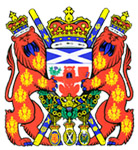
The Lord Lyon is
the sole King of Arms in
Scotland. He is Head of the
Heraldic Executive and the Judge
of the Court of the Lord Lyon
which has jurisdiction over all
heraldic business in Scotland.
|
|
|
He is assisted by
Her Majesty's Officers of Arms,
all of whom are members of the
Royal Household. There are three
senior Officers of Arms (Albany
Herald, Rothesay Herald and Ross
Herald) and three junior
Officers of Arms (Unicorn
Pursuivant, Carrick Pursuivant
and Bute Pursuivant).
The Officers of Arms may be
consulted on matters of heraldry
and genealogy by members of the
public and may represent their
clients before the Lyon Court.
The Officers of Arms also take
part in ceremonial occasions.
An Act of the Scottish
Parliament of 1592 gave the Lord
Lyon responsibility for
prosecuting as a criminal
offence anyone who uses
unauthorised Arms. The Court has
its own Procurator Fiscal, an
independent official prosecutor.
In 1672 a further Act of the
Scottish Parliament authorised
the creation of the Public
Register of All Arms and
Bearings in Scotland. This
Register is maintained by the
Lyon Clerk and Keeper of the
Records and contains an official
copy of every Coat of Arms
granted in Scotland since 1672.
|
|
|
|
|