|
|

|
|
|
|
General Information Lyon Court TRACING OF ANCESTRY, FAMILY HISTORIES ETC. We have to explain that this Department does not undertake to make researches, though the Public Registers and other collections of the Lyon Office will be made available at Search Fees for each particular search in the Register of Arms or in the Register of Genealogies and in the Heraldic and Genealogical MSS, or other collections of the Department. For this a searcher may require to be employed at a professional fee. NAME, SEPT, OR TARTAN This Department does not undertake to supply individual replies to questions regarding (a) Name (origins, etc.); (b) Sept; or (c) Tartan; for which reference should be made to the appropriate chapters of reliable books. Those under mentioned can usually be consulted in any large public library. "Heraldry in Scotland" by J. H. Stevenson (James Maclehose & Sons, Glasgow, 1914). "Scots Heraldry" by Sir Thomas Innes of Learney (Oliver & Boyd, 1956 & Johnston & Bacon, 1978). "Simple Heraldry" by Sir lain Moncreiffe of that Ilk and Don Pottinger (Thomas Nelson & Sons Ltd., 1953). Clans, Septs and Regiments of the Scottish Highlands" by Frank Adam, ed. Sir Thomas Innes of Learney (8th edition, Chapters XIII, XV, XVI, and List of Septs, pp. 554570, Johnston and Bacon, 1970). "The Highland Clans" by Sir lain Moncreiffe of that Ilk (Barrie & Rockliff, 1967). "Scottish Clan & Family Encyclopaedia" by George Way of Plean and Romilly Squire (Harper Collins, 1994). "Heraldic Standards and other Ensigns" by Robert Gayre of Gayre and Nigg (Oliver & Boyd, 1959). "Scottish Family History" by Margaret Stuart and Sir James Balfour Paul (Oliver & Boyd, 1930). Introduction regarding nature, form and sources for family histories, useful to both inquirers and family historians, and Index of published Family Histories to 1928. "Scottish Family Histories" held in Scottish Libraries, by Joan P. 5. Ferguson (Scottish Central Library, Edinburgh 1960, and revised edition compiled by Joan P. 5. Ferguson assisted by Dennis Smith and Peter Wellburn, National Library of Scotland, Edinburgh, 1986.) "The Surnames of Scotland" by George F. Black (New York Public Library, 1946).
Burke’s Peerage and Burke’s Landed Gentry
give the genealogies of many Chiefs and landed families. The Court and
Office of the Lord Lyon deals only with tartans and Septs when these
matters are brought up on Petition (or steps incidental to Petitions) for
judicial or official pronouncement, on which the relative Government dues
are exigible, and detailed evidence and proof is required. People normally
wear only the tartan (if any) of their surname, or a "district tartan"
connected with their residence or family’s place of origin. ARMORIAL BEARINGS Armorial bearings, being for distinguishing persons of, and within, a family, cannot descend to, or be used by, persons who are not members of the family. The surname indicates the family to which a person belongs. A person named Macdonald cannot bear a Ross coat of arms, or any part of it. The Chief’s coat of arms fulfils within the clan or family the same purposes as the Royal Arms do in a Kingdom. There is no such thing as a "family crest" or "family coat of arms" which anyone can assume, or a whole family can use. Armorial bearings, of which the Crest is a subsidiary part, are a form of individual heritage property, devolving upon one person at a time by succession from the grantee or confirmee, and thus descend like a Peerage. They indicate the Chief of the Family or Clan, or the Head of each subsidiary line or household descending from members who have themselves established in the Public Register of All Arms and Bearings in Scotland a right to a subsidiary version of the arms and crest, containing a mark of difference indicating their position in the Family or Clan. This is not a "new" coat of arms; it is the ancient ancestral arms with a mark of cadency, usefully showing the cadet’s place within the family.
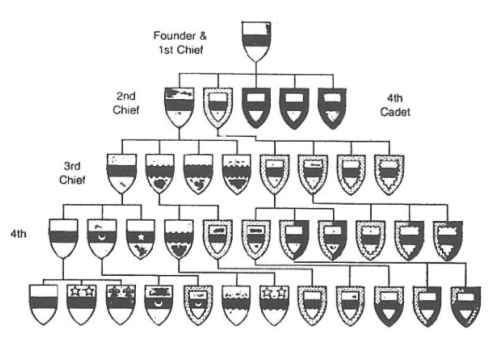
The scheme shows a few of the variations only, but illustrates how the undifferenced arms descend to, and demonstrate, the successive Chiefs of the clan or family, and how subsidiary brancharms descend to, and represent, each head of a cadethouse. Hundreds of variations are available, and use of the different shield on ones own bookplate or silverware identifies where you, and your own heirs, belong within the family. It is, as well as being beautiful, a valuable system of identification. The parts of the armorial bearings consist of: (a) The Shield, bearing the basic device; (b) The Helmet, with its Crest, which sits on top of the helmet; (c) The Motto in a scroll; (d) The Mantling or cape, which kept the sun off the wearer’s armour in hot weather; (e) Very rarely, two Supporters on either side of the shield, which are external attributes of the arms of Peers, Chiefs and a very few other persons of special importance, including Knights Grand Cross of Orders. It is illegal to assume and purport to use your Chief’s arms without a due and congruent recorded difference. Anyone who does so merely publishes their own ignorance. There is no such thing as a "Clan coat of arms". The arms are those of the Chief, and clansmen have only the privilege of wearing the strapandbuckle crested badge to show they are such Chief’s clansmen. One cannot have a crest without first having a shield of arms, because the crest was a later addition. Misuse of crests arises from misunderstanding of the badge rule under which junior members of the family may wear in specified manner their Chief’s crest as badge. CREST BADGE
Those who wish to use arms in any personal sense must petition for a Grant of Arms or—if they can trace their ancestry back to a direct or, in some cases collateral, ancestor—a "cadet matriculation" showing their place within the family. Forms of Petition and sample proofsheets relative to such applications can be supplied if required.
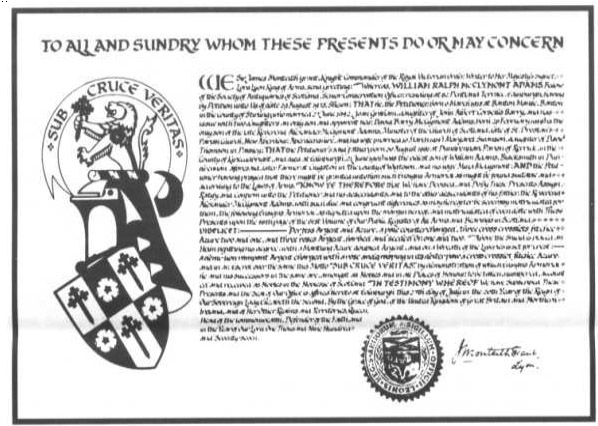
When a grant, or matriculation, of arms is
successfully obtained, an illuminated parchment, narrating the pedigree as
proved, is supplied to the Petitioner, and a duplicate is recorded in the
Public Register of All Arms and Bearings in Scotland and/or the Public
Register of Genealogies and Birthbrieves. British Commonwealth. Anyone domiciled in Her Majesty’s overseas realms or in The Commonwealth (except those of English, Welsh or Irish ancestry, who should approach Garter King of Arms in London or The Chief Herald of Ireland in Dublin) can apply to the Lord Lyon King of Arms of Scotland, H.M. New Register House, Edinburgh EH1 3YT, for a grant or matriculation of arms. Foreign Countries. Arms are not granted to nonBritish citizens (though those of Scottish ancestry can apply to the Lord Lyon King of Arms for cadetmatriculations, as above described). Moreover, even if not of direct armigerous descent, foreigners of Scottish descent can often arrange for a cousin in Scotland, or in one of Her Majesty’s overseas realms, to get arms established by the Lord Lyon King of Arms, and thereafter themselves to obtain a cadetmatriculation. Each party is in such cases supplied with an illuminated parchment.
more information -
http://www.lyon-court.com |

|

|