|
|

|
|
|
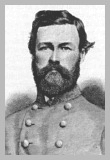
Brigadier General J. K. Duncan CSA |
|
The Story of Brigadier General Johnson Kelly Duncan CSA and the Defence of New Orleans. |
|
|
Johnson Kelly
Duncan Born: March 19 1827, York PA Died: December 18 1862, Knoxville TN Pre-War: Graduated West Point 1849, Seminole war, surveyed railroad routes, resigned 1855, civil engineer. War Service: 1861 Col. of artillery defending forts around New Orleans, January 1862 promoted to Brig. Gen., captured when the New Orleans forts fell, exchanged, assigned to Bragg's staff, died of fever. |
|
On April 13, Porter begins his bombardment of the forts of New Orleans. After 48 hours of bombardment, Lovell reports to Secretary Randolph that the forts are undamaged. Porter continues his bombardment for another week. |
|
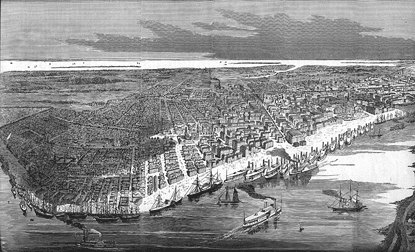
Time for a little geography. Fort Jackson is situated on the west bank of the Mississippi. Fort St. Philip is on the east bank and 700 yards upstream. In 1840, Brig. Gen. John G. Barnard (now Chief Engineer for the Army of the Potomac) had collaborated with Beauregard in rebuilding Fort St. Philip and strengthening Fort Jackson. In January, 1862 he prepared a lengthy narrative describing both forts. Fort Jackson is a bastioned pentagon with fronts of about 110 yards, constructed of brick. The scarp walls are 22 feet high and are surrounded by wet ditches. Jackson mounted |
 |
|
127 guns with 111
bearing on the channel. Fort St. Philip (established originally by the
Spaniards) was an irregular quadrilateral shape of 150 by 100 yards. The
scarp facing the river is 15 feet high. Twenty heavy guns will bear on the
river. Two external water batteries with 22 heavy guns also bear on the
river. Both forts had furnaces and 32 pound hot shot which could cause
extensive damage to wooden ships.
The Forts are part of the command of Brig. Gen. Johnson Kelly Duncan. Duncan born in York, PA in 1827, graduated from West Point in 1849, and served in Florida against the Seminoles and in the Northwest exploring routes for the Northern Pacific Railroad. He resigned from the Army in 1855 to become the Superintendent of Government Construction in New Orleans and in 1861 was the Chief Engineer of the Board of Public Works for Louisiana. Originally appointed Colonel of Artillery in command of the coast defence in and around New Orleans including Forts Jackson and St. Philip, he was promoted to brigadier on January 7, 1862 at Lovell's request. Duncan will be captured at Fort Jackson and upon release reassigned as Chief of Staff to General Bragg. He would hold this position until his death in front of Knoxville, TN on December 18, 1862. General Duncan and Commander Mitchell disagree over the placement of the Louisiana. Duncan wants the ship below the barrier near the eastern shore to catch Farragut's ships in the river bend and also to assist in the defence of the raft barricade which Farragut would cut just prior to the Union fleets ascending the river. Mitchell refuses to move and positions the ship above Fort St. Philip. Mitchell also has control of the fire rafts and fails to release the rafts according to Duncan's schedule, making it difficult for the Southern observers to see the Union preparations and harass Farragut's deployment. Not a single raft was sent down river at the appointed time. Therefore, the few sharpshooters assigned to protect the raft barricade not only failed to have the close support of the Louisiana, they were also in the dark because the fire rafts were not released as planned. Mitchell created problems with the defence of the river by failing to organise communications between the three Confederate flotillas (the remainder of the Mosquito Fleet, the River Defence Fleet and the Louisiana and her support). When Duncan tried to help, Mitchell refused to listen. According to General Lovell, the Army's rivermen of the River Defence Fleet proved "unable to govern themselves, and unwilling to be governed by others". Duncan pleaded with Lovell for support; however, when Lovell approached Commander Whittle, he did not consider himself in charge of naval affairs on the water, but agreeg to wire Mitchell. Again Mitchell refused to cooperate. At 3 AM on April 24 Farragut attacked by daylight; 14 of the 17 ships have passed the forts. Time for another question. On board the USS MISSISSIPPI was a young Lieutenant serving as the Executive Officer who would later make a name for himself. On this night, Captain Melancton Smith gave him control of the ship because Captain Smith could not see at night. Who was the 24 year old LT who would make his name in the Philippines during the Spanish American War? Answer: George Dewey the victor at Manila Bay. |
|
On the April 23, Lovell had gone down river but decided to return to the city when he became convinced that the forts could not stop the Union ships. Lovell concludes that New Orleans can not be defended. He wakes Mayor John T. Monroe and the rest of the city council members on the morning of the 24th and informs them of the situation as follows: there are only 3,000 militia available in the city and no heavy guns; and the city's current population of 170,000 could be starved into submission within 3 weeks. Lovell tells the city council that he has decided to leave New Orleans un-garrisoned instead of a military position. This measure hopefully, would prevent the city from being bombarded by the Union fleet. At 10:00 AM on April 24, Farragut proceeds upriver with 11 ships. He leaves Porter and the mortar flotilla behind to contend with the forts. Near 11:00 AM on the 25th, he attacks the defensive batteries at Chalmette. Brig. Gen. Martin L. Smith, in command of the outer defence lines, has only 20 rounds per gun and the uneven fight lasted about 30 minutes. The batteries are also at a distinct disadvantage because the majority of the cannon are pointed inland to defend against a land attack. A further additional problems was created by the unusual depth of the river from the spring rains, the Union ships are riding higher than the surrounding countryside which allows Farragut's guns to fire directly into the rear of the batteries. The Union fleet approaches the city at noon. |
|
The Mayor refuses to surrender the city citing that the city is under martial law and the demand would have to be made to General Lovell. The city is never officially surrendered. Farragut is told the city is defenceless and can not stop him from taking control, but also that the city government would not cooperate with him. Brig. Gen. Duncan holds out for a short period but finally agrees to surrender the forts. His decision to surrender is based on the loss of communications with New Orleans, after receiving reports of the investment of the forts by the Union infantry in which half of the garrison of Fort Jackson mutinied. Poor morale in the fort, (after hearing that New Orleans had fallen) also contributed to the mutiny. The Navy, under Porter, signs the surrender agreement. |
|
© John A. Duncan of Sketraw, KCN, FSA Scot. |
|