|
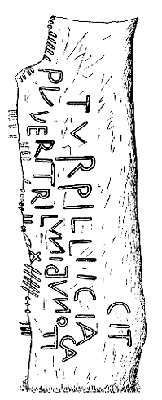
The 9ft
inscribed ‘Turpillian
Stone’ of the 4th century AD at Crickhowell, Wales is a
particular early account of the name Duncan. The Celtic Ogham – early
form of Celtic writing – on the pillar stone seems to already support an
early Latin translation incised into the stone “TURPILLI IC IACIT PUUERI
TRILUNI DUNOCATI” which according to scholars matches the Ogham markings
around the outer edge of the stone. Translated into English “He
lies here, son of Trilunus Dunocatus” - Dunocatus meaning
‘Fort Warrior’ – similar to that of the Celtic Irish, Donnocatus - Donnchad
“Brown Warrior”.
A Mr
Jones Found the stone at Ty'n y Wlad farm, Crickhowell around 1774 being
used as a foot stone across a ditch. He recognised it might be of some
historical importance and removed it from there to the edge of an adjacent
field but it had already suffered a fair amount of ware. The ‘Turpillian
Stone’ as it is known can now be found in the Brecknock Museum.
The Ulster Dalriada
or
Dál Riata Scotti (Scots) did successfully colonise the south east of
Northern Britain (Scotland) by 500AD but, they also made various
unsuccessful attempts to invade Wales. Is the ‘Turpillian Stone’ evidence of
such an earlier invasion attempt?
By John A. Duncan of Sketraw, KCN, FSA
Scot. |