|
|

|
|
|
|
The story of the Saltire the national flag of Scotland -The St. Andrews Cross. |
|
In this author’s opinion, there is nothing more beautiful than the Saint Andrew’s Cross flag of Scotland. There is something about the Saltire that stirs the blood of the Scots and reminds those of us descended from Scottish immigrants of our roots, but how many of us are aware of the history of the flag and Scotland’s connections to Saint Andrew, “the first-called” of the disciples of Jesus? The ManWhile little is known about his life, we do know that he was a fisherman from Galilee, brother to Simon, whom Jesus would call Peter, and one of the first to be called as a disciple of Christ. Andrew was believed to have been a missionary to Asia Minor and Greece, and was reportedly crucified by the Romans on an x-shaped cross at Patras, in 69 AD, as he did not feel worthy to be crucified on a cross like Christ was. His remains were entombed and in 370 AD, taken from Constantinople (where the bones had resided under the order of the Emperor Constantine) to a Pictish settlement on the Eastern coast of Scotland by Saint Rule, who was told in a vision to take the bones to the “ends of earth” for safe-keeping, and he removed a tooth, arm bone, kneecap and some fingers from the tomb in Constantinople. The settlement later became known as St. Andrews, and the relics were placed first in a small chapel, and then later in the Cathedral of St. Andrews, a center for medieval religious pilgrims (and modern pilgrims of a another sort travel there for the golf!) It is believed that the relics were destroyed during the Scottish Reformation. The larger part of St. Andrew’s remains were stolen from Constantinople in 1210 and were moved to Amalfi, in southern Italy. In 1879 the local Archbishop sent part of the saint’s shoulder blade to the Scottish Roman Catholic community, and Pope Paul VI presented further relics of the Saint in 1969, which are currently on display in St. Mary’s Roman Catholic Cathedral in Edinburgh. The Flag |
|
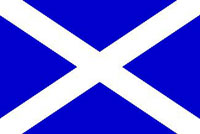
In 832 AD, a Pictish army under King Angus MacFergus, High King of Alba, along with a force of Scots under Eochaidh, King of Dalriada (and grandfather of Kenneth MacAlpin), was battling a Northumbrian force in Lothian for control of that region. The night before battle, Saint Andrew reportedly appeared to Angus in a vision, and on the field of battle the next day, a saltire, or x-shaped cross, similar to the one that Saint Andrew was crucified on, appeared in the sky, encouraging the Picts and Scots in their fight and causing the Northumbrians to flee the field, after their leader, Athelstan, was |
|
|
killed. The site of the battle was and still is known as Athelstanford, or “the ford of Athelstan”. The colours of the flag are supposed to represent the white of clouds and the azure colour of the sky. From that time onward, the Saltire became the national emblem of the Scots, not only as a flag, but also worn on tunics and bonnets of Scottish soldiers as a way to identify themselves on the battlefield. One version of the flag in the National Museum of Scotland, called the “Douglas Standard”, which reportedly was the personal flag of the Earl of Douglas and carried at the Battle of Otterburn in 1388. The flag was green, with a saltire and red heart, the symbol of the Douglas family. The saltire was also seen on the nations’ coinage, being introduced by King David the First in the 13th century. Even during the days of the Scottish Reformation, when Presbyterian reformers sought to remove all vestiges of the Catholic Church in Scotland, only the Saltire remained, and it appeared on many flags of the Covenanting forces (Scottish Presbyterians who supported the National Covenant, which stated their commitment to the Protestant Reformation) during the Scottish Revolution of 1638-1644 against the English attempt to force the Church of England on the Scots. In fact, one book, The Story of Scotland’s Flag and the Lion and Thistle, states that the “Covenanters flag” inspired the blue in the new flag of the United States during the American Revolution. In 1707,
Scotland and England joined in the Act of Union and established the United
Kingdom. A new flag representing the Union was designed, with the Crosses of
Saint Andrew and Saint George intertwined, and then later added, the Cross
of Saint Patrick was added to represent Ireland. The Cross of St. Patrick is
a red saltire on a white background, and some in Northern Ireland today who
advocate the province’s independence from Britain and the Republic of
Ireland have adopted a flag that combines the Saint Andrew’s and Saint
Patrick’s Cross. The Union flag is now commonly (and incorrectly, as a
“jack” is a flag that flies at the bow of ship, and never on land) known as
known as “The Union Jack”, and still represents the United Kingdom of Great
Britain and Northern Ireland. variations of the Saltire would be used again, this time by supporters of the exiled Stuart family, in the Jacobite Rebellions of the 1700’s. Some of these featured a gold-coloured cross instead of a white one. The flag also became the inspiration for the flags of two Canadian provinces, Nova Scotia (which also features the Lion Rampant) and Newfoundland. Russia uses a blue Saint Andrew’s Cross on a white field as a naval flag, as Andrew is also one of the patron saints of that country. Today, at Athelstaneford, there stands a memorial to the “Battle of the Saltire” in the kirkyard of Althelstaneford Parish Kirk. It was built in 1965 by the later Dr. F.R. Stevenson, and restored in 1993. It depicts the battle with the two armies facing each other and in the sky above them, the saltire of St. Andrew. Above the monument on a flagpole permanently flies a Saint Andrew’s Cross flag, which is lit even during the hours of darkness. The inscription of the memorial states:
Tradition says that near this place in times
remote
Pictish and Scottish warriors about to defeat
an army
of Northumbrians saw against a blue sky a
great white
cross like St. Andrew’s, and in it’s image
made a banner WHICH BECAME THE FLAG OF SCOTLAND. |
|
SOURCES: Scottish FAQ: The Saltire (Scotland’s Flag) http://www.scotweb.co.uk/scottishfaq/browse/the_saltire_scotland_s_flag1.html The Legend of the Saltire http://www.electrum.co.uk/cc/legend.htm Scotland’s Source: The Saltire Memorial http://www.scotlandsource.com/about/ctva2a.htm The Scottish Flag http://www.geo.ed.ac.uk/home/Scotland/saltire.html Saint Andrew http://www.geo.ed.ac.uk/home/Scotland/standrew.html Ross, David. The Story of Scotland’s Flag and the Lion and Thistle. New Lanark, Scotland: Waverly Books, 1998. |
|