| |
|
Admiral Adam
Duncan 1731 - 1804 |
|
By John A. Duncan of
Sketraw, FSA Scot. |
|
|
 |
|
Crest Badge Duncan of
Camperdown |
|
| |
 |
|
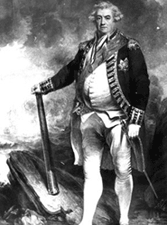
Admiral Viscount Duncan |
|
At
about the age of fifteen Adam Duncan entered the Royal Navy as midshipman
under Captain Robert Haldane, and served with him on board the "Shoreham"
frigate for three years. In 1749 he joined the Centurion, a vessel of 50
guns which was being fitted out as the flag-ship for Admiral Keppel and he
remained with this ship for six years. He was promoted to the rank of
Lieutenant on 10th January 1755 and accompanied Keppel to North America with
the British forces, serving under General Braddock, that were sent against
the French troops in that quarter. On his return to
England,
Admiral Keppel transferred his flag to the "Torbay" and Duncan
accompanied him as Second Lieutenant. For nearly three years he was retained
on the home-station and was not in active service until his ship was sent on
an expedition against the French settlement at Goree, on the African coast.
He returned thence slightly wounded, with the rank of First Lieutenant.
From this period his
promotion was rapid. On 21st September,1759, he |
|
| |
was
gazetted as a Commander and on 25th February 1761 was made Post- Captain,
and appointed to the "Valliant", a ship of 74 guns, serving again under his
steadfast friend Admiral Keppel. When the latter conducted the famous
expedition against Belleisle he hoisted his broad pennant on board the
"Valliant" and
Duncan
was honourably distinguished for his bravery on this occasion. His next
important service was in the protracted hostilities against the Spaniards in
the West Indies and after performing several brilliant exploits here he
remained with Keppel on the Jamaica Station until the conclusion of the war.
Britain then being at peace for several years, Captain Duncan was not
actively employed until the war was renewed against the combined forces of
the French and Spanish fleets in 1778 when he was appointed to the command
of the "Monarch" under Admiral Sir Charles Hardy. During the following year
the British fleet was compelled to act on the defensive because their
opponents were too powerful for them to attack with much prospect of
success. However, when British ships of war then in different parts of the
world were ordered home, a powerful flotilla was organized under Admiral
Rodney and despatched to the relief of Gibraltar at the close of 1779. Here
Captain Duncan again won distinction by his daring bravery and was
honourably noticed in the official reports of the expedition. After a brief
period of inaction he returned to Gibraltar in 1782 under Admiral Howe and
was specially mentioned for his bravery in the conflict which took place off
the Straits in October of that year. |
|
| |
On the termination of
hostilities in 1783 he was transferred to the "Edgar", a ship of 74 guns,
one of the guard ships stationed at Portsmouth. Here he remained for the
usual period of three years. On 14th September he was promoted to the rank
of Rear-Admiral of the Blue and three years afterwards he was made
Rear-Admiral of the White. He was raised to be Vice-Admiral of the Blue on
1st February 1793, Vice-Admiral of the White on 12th April 1794 and Admiral
of the Blue on 1st June 1795. This rapid promotion seems to indicate that
his services were highly appreciated, yet it is stated that he considered
himself as under-valued. He frequently solicited command but his request was
not complied with, and in consequence, it is said that he had it in
contemplation to retire altogether from the service and to accept a civil
appointment connected with the Navy. But in April 1795 he was placed in a
position which enabled him to show his capacity and to win immortal renown
when he was then appointed Commander-in-Chief in the North Seas and hoisted
his flag on board the "Venerable", a ship of 74 guns - This vessel was
afterwards made memorable in connection with his name. |
|
 |
|
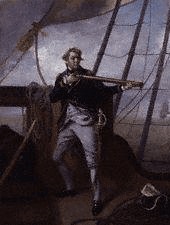
Captain Adam Duncan
1792 |
|
|
| |
After
a short but successful cruise in the North Sea he returned to England in
1797 with several French and Dutch prizes and whilst his fleet was lying in
Yarmouth Roads he managed by his intrepid conduct to quell the first
symptoms of disaffection amongst the men under his command; who had been
encouraged to revolt after the incident of the Mutiny at the Nore.
On the
11th of October while cruising off the tiny village of Kampen the Dutch
fleet appeared. The Dutch were commanded by Admiral de Winter and Duncan is
said to have told his officers "Gentlemen, you see a severe winter
approaching. I advise you to keep up a good fire." |
|
| |
 |
|
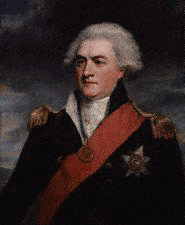
Admiral Duncan 1798 |
|
Amid the noise, flames and smoke of battle many died. Duncan’s own ship, the
Venerable, took many direct hits and when his admiral's flag was shot down
he retrieved it himself and handed it to Ordinary Seaman, Jack Crawford, who
famously volunteered to climb the mast to re-attach it. Duncan had
previously observed that he intended to fight on until his flagship sank. "I
have taken the depth of the water” he told one of his captains, "and when
the Venerable goes down my flag will still fly."
With
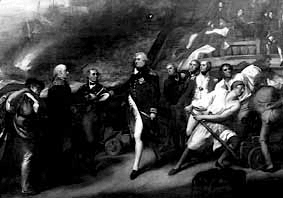
de Winter's surrender, Admiral Duncan was able to claim 11 ships as prizes;
a remarkable achievement from a fleet of just 18 ships. Duncan's victory
relieved the threat of invasion. He arrived back at Yarmouth on 18th
October 1797 to a hero's welcome.
He was
awarded the Large Naval Gold Medal and a pension of £3000 |
|
| |
per year; nowadays around
£300,000. It was the biggest pension ever awarded by the Government. He was
given the freedom of several cities, including Dundee and London. He was
created 1st Viscount Duncan of Camperdown and awarded the lands which are
now Camperdown country park and mansion. He was made Baron Duncan of Lundie;
his family home on the Perthshire-Angus border.
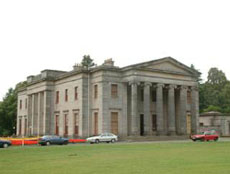
With the pension, he built
the imposing neo-classical Camperdown House beside his home city of Dundee.
The last member of the family to live at Camperdown was Lady Buckingham, a
cousin to the last Earl of Camperdown and great-grand daughter of the
Admiral himself, she resided there until her death in 1937. |
|
 |
|
Camperdown House Dundee |
|
|
| |
He died on August 4,
1804, aged 73, and is buried in the little churchyard at Lundie |
|
| |
|
 |
|
Admiral Duncan receiving the Dutch |
|
surrender after the battle of
Camperdown |
|
|
|
| |
|
Early in 2008 a 'mud
lark', Mr A. Richards, made a wonderful discovery on the banks of the
River Thames, London, a single cufflink. The cufflink, the only one known
to exist, would have been presented to one of the officers who served with
Admiral Adam Duncan of Lundie as a way of celebrating his victory at the
Battle of Camperdown, 11 Oct. 1779, against the combined Dutch & French
Fleets.
The Clan Duncan Society
has commissioned Roddy Young, Goldsmith & Silversmith, Inverness, to
re-create this unique find in a Numbered & Strictly Limited Edition
of 150, in either Sterling Silver (18 grams), 15K Gold (20 grams) or 18K
Gold (21 grams), each with a diameter of 13mm and hallmarked in Edinburgh.
Each set is individually numbered, handmade to order and comes in a
presentation box with a certificate of authentication. Please visit the
Society's Online Shop for more details
and an image of cufflinks. |
|
|
|
|
