| |
|
CULLODEN
MOOR
AND
THE STORY OF THE BATTLE |
|
Night March Towards
Nairn - Chapter 3 |
|
| |
 |
|
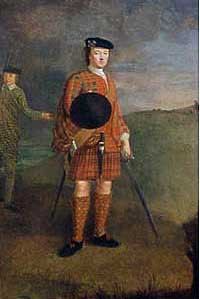
Lord George Murray |
|
|
ANOTHER bold scheme was
meanwhile resolved on - a night-attack on the English camp at bairn. It was
hoped, too, that the Soldiers might be the more likely to be found napping,
as they might be expected to over-indulge in the festivities of their
leaders birth-day. Lord George devised or cordially adopted the proposal, it
would seem, for one reason, as preferable to awaiting the Royal army on the
ill-selected field of battle. It was about three o'clock in the afternoon of
15th April that the project was resolved on; the intention being to set out
at night-fall, about eight o'clock, with the purpose of reaching the point
of attack about two o'clock in the morning. By some fatality, through a
negligence which was attended with the most disastrous consequences, a
single biscuit or a small loaf or oatmeal bannock, was all of nourishment
that was available for each man. Difficult as may have been the duties of
the commissariat, they ought, at this eventful crisis, to have been
prosecuted with all possible energy; and that they might have been so
successfully, was demonstrated by the fact, that on a serious but too late
effort being made, a store of food was collected, though not in time to
reach the famished troops. In the Lockhart Papers (vol. ii. p. 529), Mr.
John Hay is said to have been blamed by the army for the distress they were
in for want of provisions, he having the superintendence at the time, owing
to the illness of Secretary Murray, who is there stated to have been
extremely active in providing for the army.
"The scarcity of provisions" (says Mr. Chambers) "had none become so great,
that the men were on this important day reduced to the miserable allowance
of only one small loaf, and that of the worst kind. Strange as the averment
may appear, I have beheld and tasted a piece of the bread served out in this
occasion, being the remains of a loaf or bannock, which had been carefully
preserved for eighty-one years by the successive members of a Jacobite
family. It is impossible to imagine a composition of greater coarseness, or
less likely to please or satisfy the appetite: and perhaps no recital,
however eloquent, of the miseries to which Charles's army was reduced, could
have impressed the reader with so strong an idea of the real extent of that
misery as the sight of this singular relic. Its ingredients appeared to be
merely the husks of oats and a coarse unclean species of dust, similar to
what is found upon the floors of a mill."
The quality of the bannock in question may possibly have been exceptional;
but whether so or not, the quantity on that day was at starvation-point for
soldiers in the field. Lord George, in his letter, 5th August 1749, to
Hamilton of Bangour, says, with reference to the want of provisions, as an
alleged reason for not shifting their ground, "I was convinced there was
enough at Inverness which might even then have been brought out, part to
where we were, and part to Loch Moy, where our army must have retired if the
Duke of Cumberland did not cross the Water of Nairn and give us an
opportunity of fighting him to advantage."
The first evil consequence of a want of a supply of provisions, was that the
men had gone to Inverness and about the country in search of indispensable
food. On the night-march being resolved on, the officers went in search of
the stragglers; "but, under the influence of hunger, they told their
commanders to shoot them if they pleased, rather than compel them to starve
any longer." Of the whole army concentrated at and about Inverness, which
comprised about 6000 men, less than two-thirds assembled in the evening. In
these circumstances it is no wonder that Lord George Murray says - "Then,
indeed, I do not know of one officer who had been made acquainted with the
resolution of surprising the enemy, but declared, in the strongest terms,
for laying it aside; much was spoken by them all for not attempting it then;
but his Royal Highness continued bent on the thing, and gave me orders to
march (he embraced me at the same time), which I immediately did."
|
 |
|
|
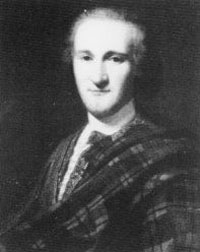
Lord John Drummond |
|
|
It was in this untoward
state of affairs that the unfortunate night-march to Nairn was commenced.
The expedition marched in two consecutive columns; the first, commanded by
Lord George Murray, was composed of the Clans: Lord John Drummond was with
the rear of this division. The second column, commanded by the Duke of
Perth, consisted chiefly of the Lowland regiments, and the Prince and he
were in the central interval, of about a quarter of a mile, between the two
columns. Twenty to thirty of the men of the MacIntosh regiment, who were
familiar with the line of march, and two officers, were distributed along
the columns as guides. The first column comprised about a third of the whole
force; and the intention was that they should cross to the south side of the
Nairn when within about 3 miles of the town, and then recross and attack the
English army in flank and rear, simultaneously with the onset on the west by
the second column.
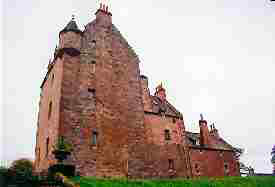
The route lay near Dalcross
Castle, an interesting structure, built in 1620 by Simon, sixth Lord Lovat,
but then and still the property of MacIntosh of MacIntosh, which is
conspicuous on the summit of the ridge, about 3
miles |
|
north-west from the scene
of battle, and at a little distance north of Kilravock Castle, which, with
other buildings overhanging the river, about three miles beyond Dalcross,
has a fine old tower of the 15th century, and belongs to a family - Rose of
Kilravock, at one time powerful in the North - remarkable for an unbroken
male descent, retaining their baronial estate for six centuries without the
support of any clan of their name, in the midst of jealous and ferocious
neighbours.
The night was very dark,
the way devious, as houses were avoided; the ground was rough, and, there
being many obstacles, the men straggled a good deal. The rear column did not
keep pace with that in front, possibly in part owing to its members not
being all so nimble of foot, nor so accustomed to moor ground and rough
footing as the clansmen, though even of these several fell behind, some from
exhaustion. Repeated interruptions were accordingly experienced to the
advance of the leading column, by messages to halt or slacken pace. By the
time the front rank had reached Knockanbuie, "the yellow knoll,"
intermediate between the present road from Clephantown - a small hamlet on
the line of the old military road, now leading from Fort-George past Cawdor
- to Nairn, and the river, rather more than a couple of miles beyond
Kilravock and nearly double that distance from Nairn, it was found to be
then so late as two o'clock of the morning, the hour of meditated attack.
The leaders, in a brief consultation, came to the conclusion that it would
be vain to persevere, with any hope of not being discovered long before they
could come upon the enemy. The roll of a distant drum, indicating the
English to be on the alert, quickened their deliberations. Lord George,
therefore, on his own responsibility, according to some accounts - but
according to himself and others, not without communication with the Prince -
ordered the column to retrace their steps. Lord George himself says - "Mr.
O'Sullivan also came up to the front, and said his Royal Highness would be
very glad to have the attack made: but as Lord George Murray was in the van,
he could best judge whether it could be done in time or not. Perhaps Mr.
O'Sullivan may choose to forget this, but others are still alive who heard
him."
The Prince's indignation was great on ascertaining this retrograde movement,
and he is said to have exclaimed that Lord George Murray had betrayed him.
But there is much to say for the view that it was in the exercise of a wise
discretion that the attempted surprise was abandoned, and the Prince
afterwards acknowledged as much. Had it been persisted in, the enemy would
not have been taken quite at unawares, as the Duke of Cumberland had been
advised of his adversary's approach by scouts who mingled in the ranks;
though all that he seems to have apprehended, as the purpose of a night
attack had been confined to a very few, was, that the Highland army were
about to take up a position near him in order to offer battle on the
following day; for his men were ordered to seek repose, but with their arms
at hand. Besides, this vigilant commander had a party of dragoons patrolling
all night on the side next the Insurgents, between the river Nairn and the
sea. |
|
On the other hand, the
fortunes of the Insurgents were in a most critical condition. They were
without money and without provisions. Mr. Hepburn of Keith advised to
proceed; that it was easier to attack than to retreat, as they would be
compelled to fight when in a worse condition. The late Sir Henry Steuart of
Allanton, Bart., in his able review of Home's History of the Rebellion
(Anti-Jacobin Review, vols. xii. and xiii.), condemns the resolution
adopted as the worst of two evils:-
"It has always been a
favourite maxim (he argues) with the greatest generals, from Julius Caesar
to Marshal Suwarrow, rather to attack an enemy than to wait to be attacked,
for the double purpose of giving confidence to their own troops,
and striking with terror those of an |
| |
 |
| |
Dalcross Castle |
|
|
opponent. Had the
Highlanders been led on with promptness and rapidity, even after daybreak,
they would, in the first place, have possessed this unusual advantage, and
it would have been increased by their own characteristic impetuosity."
He then points out that the
character of the ground on the south of the encampment, of which he presumes
Lord George could not be ignorant, was capable of screening the attacking
party on that side from observation and from the range of artillery; while
he considers that the crossing and recrossing of the river would have
deceived the vigilance of the enemy's spies and patrols. The situation was
perhaps one of those desperate ones where the flower Safety is only to be
plucked from the nettle Danger. It is easy, however, to allege an error in
judgment after the event; and as nothing could have been more fatal than the
predicament in which they were placed on Culloden Moor, doubtless the attack
on the camp at Nairn might have been attended with a better issue.
The luckless Highlanders, returning by the Church of Croy, arrived about six
in the morning, fatigued, famished, and disheartened, at that part of the
Parks of Culloden indicated, as already described, by a hollow south of the
plantation outside of the birch wood west of the farm-house of Drumbuie, and
about three-fourths of a mile above Cuiloden House. In the map, which is
reduced from one published in 1845 by the late Mr. John Gowie,
land-surveyor, Inverness, the lines of march and of retreat are both laid
down to the north of Dalcross Castle. Mr. Gowie was very painstaking, and
pretty fresh information was to be then had: so that in all probability he
has succeeded in indicating the routes with accuracy.*
[* The line of pursuit by the Royal army has, however, been brought
nearer to Dalcross Castle. There is a common tradition that the Royal army
rested in an arable field below and about a quarter of a mile from the
Castle, in which it was apprehended there would consequently be no crop that
year, whereas there was an unusually abundant one. Some other slight
corrections have also been found necessary.]
Many of the men lay down to snatch a few hours of much-needed sleep in the
open air. The whole army had bivouacked the previous night in like fashion,
without any tents or covering to protect them from the inclemency of the
weather, which was very severe and cold. Hundreds, too, wandered away in
search of wherewithal to stay the cravings of hunger. The Prince himself
could command no better refreshment than some bread and whisky.
LORD GEORGE MURRAY.
Sir Henry Steuart, whose authority is the more trustworthy that he had been
long employed in collecting materials for a history of the different
attempts subsequent to 1688 for the restoration of the House of Stuart, in
the before-mentioned Review thus portrays the character of Lord George
Murray, on whose memory rests the praise or blame of the retreat:-
"In the Highland army he was the person by far the best fitted for the
foremost station, and accordingly be acted as Lieutenant-General of the
forces under the orders of the Prince, who only nominally exercised the
supreme command. Lord George, as a man, had talents that were far above
mediocrity; and whatever may have been whispered by the voice of slander he
was sincerely attached to the Stuarts' cause. As a soldier he was brave,
active, and vigilant, fertile in his resources, and ardent in his
enterprises, yet what he conceived with boldness and planned with address he
was not always able to carry steadily into effect; and he was without that
firm perseverance which presses forward to its object in spite of the
caprices of accident and the unexpectedness of opposition. It is worthy of
remark that, as Lord George had the command of the Rebel army, this want of
perseverance, which he so eminently discovered, gave a visible complexion to
the chief events of the war. In the counter-march from Derby " [of which the
reviewer elsewhere says, "That Lord George Murray, who began to waver in his
resolution, was the author of this retreat, there is no sort of doubt"] "it
was fatally conspicuous. The retreat from Stirling furnished another
example; and the failure of the night-attack at Nairn, which closed the
catalogue certainly paved the way for extinguishing the Rebellion."
|
 |
|
|
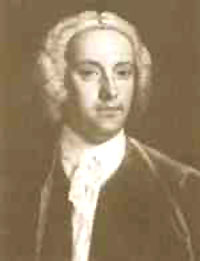
Lord George Murray |
|
|
Sir Henry, however,
unreservedly exonerates this gallant soldier from the imputations made on
his integrity and good faith, thus - "In regard to the question concerning
Lord George Murray, it appears to us, both from internal and external
evidence, that there is not the slightest ground for suspecting the
sincerity of that spirited and able partisan. Secretary Murray, we know,
purchased his life with the price of his honour, and was in consequence
despised and reprobated by all parties. But Lord George was incapable of an
unworthy sentiment, and his whole conduct during the war, and long after its
termination, affords the amplest evidence of an unblemished character. He
who examines his able letter to Mr. Hamilton, where his sentiments and
principles are clearly stated, and compares it with the seeming infatuation
of the Rebels before the battle of Culloden, and the influence which Sir
Thomas Sheridan and the Irish had acquired over the Prince's mind, will at
once perceive not only that the evil originated with those weak advisers,
but that no exertion of Lord George's was left untried to preserve the army
from the catastrophe that ensued. That he imprudently, as well as
impatiently, abandoned the night attack, it is impossible to deny; but that
as well as his other errors candour will |
|
attribute to the defects of
his judgment, not to the corruption of his heart. Even late as it was, after
the countermarch from Kilravock, had his original advice of occupying the
strong ground been accepted, there is no ascertaining to what period it
might have protracted the war."
It must be observed that Lord George on all the occasions in question
carried with him the concurrence of the Highland chiefs. No wonder that
their resolution misgave them when they found themselves in the heart of
England with a handful of men, and when French and English alike gave no
sign. Lord George persevered to the utmost limit admitting of an
alternative. He out-manoeuvred the Duke in the last onward as well as in the
retrogradw movement; and at Clifton he, with Cluny's and the Glengarry men,
John Roy Stewart's regiment, and the Stuarts of Appin, gave the dragoons a
lesson which effectually prevented all further annoyance in pursuit. But the
whole was a desperate neck-or-nothing game, in which, having once embarked,
it became at every juncture about as hazardous to recede as to go forward.
Having once turned back in their onward progress to the Capital, all hope of
ultimate success at least was at an end, and no reasonable expectation could
have been entertained, beyond that of compelling something like fair terms,
by protracting hostilities, for which the Highlands afforded every facility. |
|
|
